
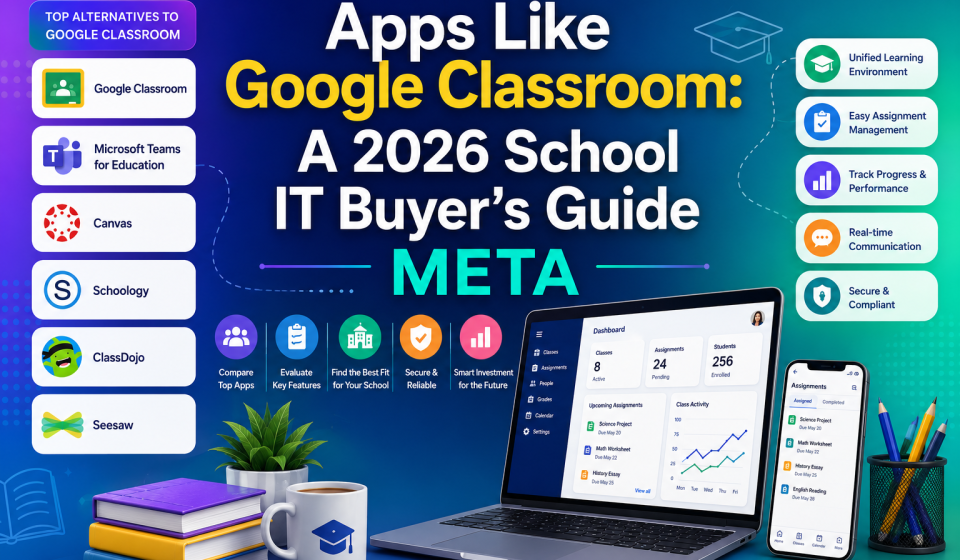

Almost every guide to apps like Google Classroom is written for teachers. Very few are written for the person who provisions the accounts, syncs the rosters, rotates the API keys, and picks up the phone when a platform goes dark during finals week.
Table Of Content
- Why schools are looking for apps like Google Classroom in 2026
- What Google actually changed
- Three categories that get collapsed into one list
- Apps like Google Classroom compared: the 2026 shortlist
- The Canvas breach reset the risk calculation
- What actually breaks when you migrate
- Questions to settle before you shortlist anything
- The layer nobody scopes
- Frequently asked questions
- Is Google Classroom still free in 2026?
- What is the closest free alternative to Google Classroom?
- Is Canvas Free-for-Teacher coming back?
- Which apps like Google Classroom are safest after the 2026 breaches?
That gap matters more than it used to. In 2026, the reasons schools leave Google Classroom stopped being pedagogical and became operational.
Two things happened. Google rewrote its education licensing between October 2025 and February 2026, and the free staff license disappeared. Then, in late April, Instructure’s Canvas was breached twice inside nine days – after which the company permanently discontinued Free-for-Teacher, the exact product that half the “best alternatives” listicles still recommend today.
If you are evaluating apps like Google Classroom right now, much of what ranks for this query describes a market that no longer exists. Here is the current one.
Why schools are looking for apps like Google Classroom in 2026
Start with a correction, because it drives most of the bad advice in this category: Google Classroom is not the thing that costs money.
Classroom ships inside Google Workspace for Education Fundamentals, free for qualifying institutions, with 100 TB of pooled storage. Nobody is leaving over Classroom’s sticker price. They are leaving because of what Fundamentals doesn’t do – roster sync from your SIS, originality reports, security analytics – and because the tier that fixes that got materially more expensive.
What Google actually changed
Three shifts, and the third is the one that hurts.
Google raised list prices: Education Plus moved from a suggested $5 to $6 per user per year, the Teaching and Learning add-on from $48 to $60, and flexible plans from $4.80 to $6 per user per month.
Then the structural change. Under the old model, buying Education Plus or Standard earned you one staff license free for every four paid student licenses. That is gone. Minimum purchase is now the sum of total enrollment – full and part time – plus every active staff member holding a Fundamentals license. Institutions under 50 combined users must still buy 50.
Run the arithmetic on a school with 1,200 students and 140 staff. Previously: 1,200 student licences at $5 covered it and threw in 300 free staff seats – more than enough for 140 people. Call it $6,000. Now: 1,340 licences at $6 is $8,040. Same school, same software, roughly 34% more.
Timing depends on your paperwork, not your calendar: new purchases and downgrades repriced from October 1, 2025; renewals and upgrades from February 1, 2026; Flexible Plan customers no sooner than March 4, 2026. Standard and Plus are annual-commitment only – cancel mid-term and you owe the balance. One lever: renewing Plus customers increasing licences by 10% may qualify for a 10% first-year discount, available until February 1, 2027.
None of that makes Classroom a bad product. It makes the upgrade path a budget event – and budget events are what start migrations.
Three categories that get collapsed into one list
Most roundups of apps like Google Classroom rank Moodle against ClassDojo. That comparison is meaningless, and it is the single biggest reason schools buy the wrong thing.
There are really three groups. Full learning management systems – Canvas, Moodle, Brightspace, Blackboard, Schoology – do gradebooks, assessment engines, LTI tool integration, and SIS roster sync. Productivity suites with a classroom layer – chiefly Microsoft Teams for Education – give you an identity tenant and device management with teaching bolted on. K-8 classroom and communication apps – Seesaw, ClassDojo – do portfolios and parent messaging, and were never LMSs at all.
Google Classroom sits between the first two: a thin assignment layer over Workspace, which is why it is so easy to adopt and so limiting at district scale. Replace it with a real LMS and you are not swapping an app – you are adding a system of record, and everything downstream of it changes.
Apps like Google Classroom compared: the 2026 shortlist
Prices below are 2026 list figures where vendors publish them. Canvas, Brightspace, Blackboard and Schoology negotiate every deal, so treat those ranges as buyer-reported, not quoted.
| Platform | 2026 licensing & list price | SIS / roster sync | Where the admin load lands | Honest fit |
| Google Classroom (Workspace for Education) | Fundamentals free; Plus $6/user/yr; T&L add-on $60/user/yr. Every active user must be licensed | Roster sync requires Education Plus or a third-party connector | Low day-to-day; cost spikes at renewal under the new per-user minimums | Chromebook districts already standardized on Workspace |
| Microsoft Teams for Education (M365 A1/A3/A5) | A1 free; A3 ~$3.25/user/mo; A5 ~$8/user/mo (faculty list). Student Use Benefit covers students at 40:1 against licensed faculty | School Data Sync; strong Entra ID identity story | Tenant and Intune configuration is the real work, not the classroom layer | Windows/Surface estates; anywhere faculty already sit on A3+ |
| Canvas (Instructure) | Negotiated. Buyer-reported ~$8–12/user/yr under 5,000 users, ~$3–6 at 20,000+. Free-for-Teacher permanently discontinued May 2026 | Native, mature; PowerSchool/PeopleSoft connectors standard | Implementation and LTI governance; migration services often quoted from $10k | Higher ed and large districts needing a genuine assessment engine |
| Moodle | GPL, $0 licence. MoodleCloud ~$130/yr (50 users) to ~$1,720/yr (750 users, hard cap). Workplace via partners | Full LTI/SCORM/xAPI; SIS sync via plugins | You are the vendor. Realistic self-hosting is 0.25–1.0 FTE of sysadmin time | Data-residency mandates, or existing Linux capability on payroll |
| Schoology Learning (PowerSchool) | Negotiated; commonly cited ~$2–5/student/yr as a PowerSchool SIS module | Tightest K-12 SIS integration on the market – it is the same vendor | Low, if you already run PowerSchool SIS. Concentration risk is the trade | K-12 districts already committed to PowerSchool |
| Seesaw / ClassDojo | Free tiers; paid school plans quoted per site | Limited; not an SIS system of record | Minimal | K-8 portfolios and parent comms – a complement, not a replacement |
The Microsoft Student Use Benefit is the sharpest contrast with Google’s new model: licensing faculty on A3 or A5 extends equivalent capability to students at a 40:1 ratio, with no additional per-student charge. Google now requires a paid licence for every active user. For 140 staff and 1,200 students, those two rules produce very different invoices – and that, not feature parity, usually decides the bake-off.
MoodleCloud’s 750-user ceiling ends the conversation for most districts before it starts. Above that you self-host, and self-hosted Moodle is free the way a puppy is free.
The Canvas breach reset the risk calculation
The 2026 listicles have not caught up with this, and it should change how you read every row above.
Unauthorized actors accessed Canvas systems around April 25, 2026. Instructure detected the intrusion on April 29, revoked access and brought in outside forensics. It disclosed on May 1 and said the incident was contained by May 2 – usernames, email addresses, student ID numbers and messages between users were involved. Instructure maintains it found no evidence that passwords, dates of birth, government identifiers or financial data were exposed.
Then on May 7, the same actor returned through a second vulnerability and defaced login pages. Instructure took Canvas into maintenance mode mid-finals. ShinyHunters claimed data on roughly 275 million people across nearly 9,000 schools – a figure Instructure has never confirmed. On May 11 the company reached an agreement with the actor; a proposed class action followed on May 13. The University of California ordered campuses to block Canvas; Queensland’s Department of Education, RMIT, 44 Dutch institutions and eight-plus Canadian universities pulled access. The US Department of Education opened FERPA inquiries.
The root cause Instructure confirmed publicly: an issue related to Free-for-Teacher accounts – the no-cost tier living outside enterprise-managed environments. It is now permanently discontinued; former users got an export window during the week of May 28, and Instructure says a replacement is due in the fall.
Now hold that next to PowerSchool. In December 2024 an attacker used stolen contractor credentials against PowerSource – PowerSchool’s support portal, which had no MFA – and took records for roughly 62 million students and 9.5 million educators. PowerSchool owns Schoology Learning and runs about 75% of the North American K-12 SIS market.
Neither breach was a failure of a gradebook. Both came in through the periphery: a free account tier outside enterprise management, and a support portal outside the MFA policy. The LMS you choose matters less than the account and integration surface you attach to it. Any comparison of Google Classroom alternatives that stops at feature checklists is measuring the wrong thing.
What actually breaks when you migrate
Every vendor selling apps like Google Classroom scopes the platform itself. Nobody scopes what follows.
| Workstream | What it actually involves | Where it goes wrong |
| Identity & SSO | Federating the new LMS to your IdP; enforcing MFA on every tier, including guest and free accounts | Free/legacy account types silently sit outside policy – the Canvas root cause |
| Roster sync | SIS → LMS provisioning and, critically, deprovisioning | Leavers keep access for a term; Google roster sync needs Education Plus, which people discover after signing |
| Content migration | Course exports, Drive dependencies, embedded links | Classroom content is Drive-shaped; links survive export, permissions don’t |
| Integrations & LTI | Cataloguing every LTI tool, API token, and connector touching the LMS | Nobody has the list. Post-incident, Instructure told schools to rotate LTI tools, SSO connectors and API keys – you cannot rotate what you cannot enumerate |
| Device fleet | Chromebook enrolment, MDM policy, reimaging if you cross ecosystems | A Workspace→M365 move is a device project wearing an LMS costume |
| Licence reclamation | Reclaiming seats from leavers before renewal | Under Google’s per-user minimums, every stale active account is now a line item |
| Support load | The ticket surge in weeks 1–6 | Budgeted at zero. Runs 2–3x baseline |
The pattern across all seven is the same: choosing the LMS is the small part. The identity, asset and integration inventory underneath it is the project.
Questions to settle before you shortlist anything
Work through these honestly before you take a single demo. If you cannot answer them, you are not ready to choose between apps like Google Classroom – you are ready to do discovery.
- What is your actual renewal date, and which pricing regime does it fall under? Google’s changes hit new purchases, renewals, and flexible plans on three different dates. This single fact reprices the whole comparison.
- Can you produce, today, a list of every LTI tool, API token, and connector touching your current LMS? If not, that is your first project regardless of which platform wins.
- Does every account tier sit behind MFA – including free, guest, and teacher-created accounts? Both major edtech breaches of the last 18 months entered through tiers that didn’t.
- Who owns roster deprovisioning, and can they prove a leaver loses access same-day? Under per-user licensing, this is now a cost control, not just hygiene.
- Is your objection to Google Classroom pedagogical or financial? If it is financial, model Microsoft’s 40:1 Student Use Benefit against Google’s per-user minimum before you look at features at all.
- Do you have the FTE to self-host? Moodle’s licence is free. A quarter to a full sysadmin FTE is not.
The layer nobody scopes
Read Instructure’s own post-incident guidance again: rotate local Canvas integrations, LTI tools, SSO connectors and API keys, and review authentication and integration logs for the April 25 – May 8 window.
Every one of those instructions presupposes an inventory. You cannot rotate credentials for integrations you have not catalogued, or review access logs for systems you did not know were connected. In most districts that inventory lives in a spreadsheet that went stale two reorganizations ago.
This is asset and service management work, not LMS work, and it is where the platform decision quietly becomes an operations problem. Which devices touched which platform, which staff accounts still hold licences, which integrations were live during an exposure window – that is the substrate any migration runs on. Tools built for it, like Alloy Software’s IT asset management platform, exist because the alternative is reconstructing the picture during an incident, from memory, at 2 a.m.
The same logic applies to the ticket surge. Plan on two to three times baseline volume for the first six weeks – and in a shared inbox you lose the signal – the three tickets showing a broken roster sync sit buried under two hundred password resets. An IT service management platform that ties tickets to assets and users is the difference between catching that in an hour and catching it in a fortnight.
Frequently asked questions
Is Google Classroom still free in 2026?
Yes. Classroom is included in Google Workspace for Education Fundamentals, still free for qualifying institutions. The paid tiers changed: Education Plus rose to a suggested $6 per user per year, and the free staff licence – one per four paid student licences – was eliminated. Every active user now needs one.
What is the closest free alternative to Google Classroom?
Microsoft Teams for Education under the A1 licence is the nearest like-for-like, and it is a real free tier rather than a trial, covering web Office apps, Teams, Class Notebook and Forms for eligible institutions. Self-hosted Moodle is free by licence but costs 0.25–1.0 sysadmin FTE to run properly.
Is Canvas Free-for-Teacher coming back?
No. Instructure permanently discontinued Free-for-Teacher after confirming the 2026 breach exploited an issue related to those accounts. Users were given an export window during the week of May 28, 2026. Instructure has said an enhanced product built with former Free-for-Teacher users in mind is expected in the fall.
Which apps like Google Classroom are safest after the 2026 breaches?
Wrong question, and it leads to bad procurement. Neither the Canvas nor the PowerSchool breach exploited teaching features – both entered through peripheral surfaces (a free account tier, an MFA-less support portal). Assess the vendor’s account model, MFA enforcement across every tier, and integration governance rather than the platform’s brand.
Pick the platform second. Before you shortlist apps like Google Classroom, inventory the identity, device and integration surface you already own – that is what the 2026 breaches exploited, and what every migration estimate omits. When the next outage lands mid-term, the useful question will not be which LMS you picked. It will be whether you can say, immediately, what was connected to it.