

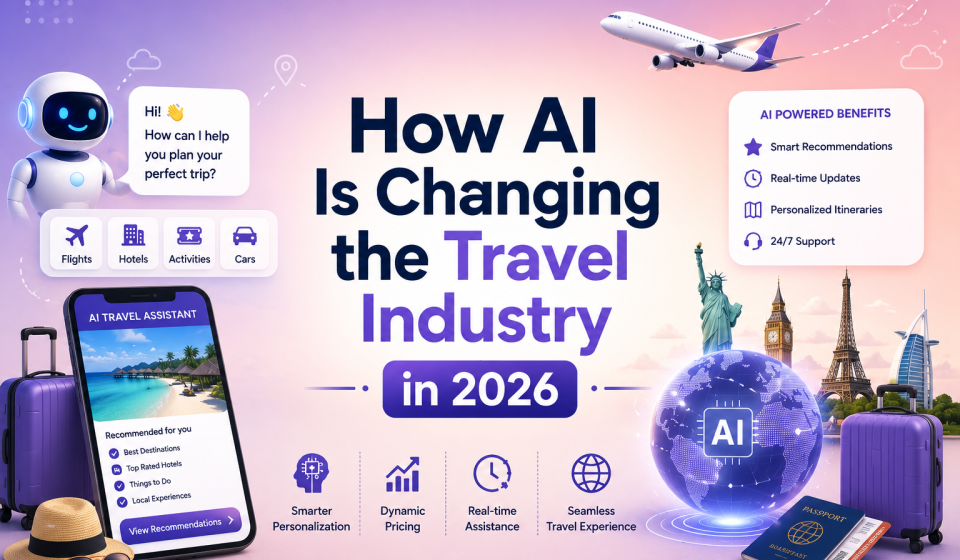

A traveler searching for a flight today rarely sees the same price twice. Refresh the tab, and the number moves. That single detail – a fare that shifts between two page loads – says more about how AI is changing the travel industry than any list of chatbot features ever could.
Table Of Content
- From Search Boxes to Agentic Booking
- Dynamic Pricing Now Runs on a Different Clock
- The Data Collection Problem Hiding Behind the Dashboards
- Personalization Runs Into a Privacy Ceiling
- LLM-Driven Discovery Is Rewriting Travel SEO
- Where Infrastructure Meets Strategy
- Practical Lessons for Teams Building This
- Where This Goes Next
Behind that flickering price tag sits a machine that reads demand, weather, competitor rates, and booking velocity in near real time, then decides what you should pay. This is not a future scenario. It is how airlines, hotel chains, and online travel agencies already operate in 2026, and the pace of change is accelerating rather than slowing down.
This piece looks at where AI in the travel industry is actually delivering results, what breaks when travel companies try to scale it, and the data infrastructure question that rarely makes it into the trend reports.
From Search Boxes to Agentic Booking
For two decades, travel discovery ran through the same pattern: a traveler typed a destination and two dates into a search box, then compared a list of results. That pattern is dissolving.
Deloitte’s 2026 travel outlook found that generative AI use in trip planning roughly tripled between 2023 and 2025, and the shift shows up in how people phrase requests. Instead of short keyword searches, travelers now describe a mood, a budget, a group of companions, and a list of constraints in a single prompt, expecting the system to assemble the trip rather than just list options.
IDC’s hospitality and travel forecasting goes further, projecting that AI agents will handle a meaningful share of bookings by the end of the decade, with the first point of contact increasingly being an autonomous agent rather than a human browsing a website. Airlines are responding by rebuilding their backend around Offer and Order models, which represent inventory as flexible, machine-readable bundles instead of fixed fare classes tied to a reservation record.
For product teams, this changes what “discoverability” means. Ranking on a search engine result page still matters, but being interpretable by an AI agent – structured data, accurate live inventory, clear pricing logic – is becoming just as important.
Dynamic Pricing Now Runs on a Different Clock
Airline and hotel pricing has used algorithms for years. What changed in 2026 is the frequency and the input set. Revenue management systems now blend historical booking curves with live demand signals, local events, weather disruption forecasts, and continuous competitor rate feeds, adjusting prices multiple times an hour instead of once a day.
RateGain’s 2026 competitive pricing research puts a number on this: more than six in ten travel businesses are now experimenting with or actively scaling AI-driven rate parity monitoring, tracking competitor prices across dozens of channels and hundreds of points of sale simultaneously. The businesses that win, according to that research, are not the ones that simply collect the most rate data – they are the ones whose systems act on it within minutes rather than days.
That distinction – collecting data versus acting on it – is where most of the real engineering effort in travel AI actually goes, and it’s rarely the part vendors put on a landing page.
The Data Collection Problem Hiding Behind the Dashboards
Every dynamic pricing engine, every rate parity tool, every AI-generated itinerary recommendation depends on one unglamorous input: continuous, geographically accurate data pulled from competitor sites, metasearch engines, and booking platforms. That data has to look like it came from a real traveler in a real country, or the numbers it returns are wrong.
Travel and hospitality sites are also some of the most aggressively protected targets on the web, because rate data has direct revenue value. Anti-bot systems fingerprint browser sessions, rate-limit by IP, and serve different prices depending on detected location – which means a monitoring system running from a handful of static IPs in one data center will see a distorted, incomplete market picture within days.
The table below summarizes the friction points that show up most often when travel teams try to run price monitoring at scale, based on patterns reported across the current proxy and web-scraping literature.
| Friction Point | Typical Cause | Effect on Data Quality |
| Geo-mismatched pricing | Requests routed through the wrong country or region | Rate comparisons across markets become invalid |
| Session blocking mid-crawl | Repeated requests from the same IP range within a short window | Incomplete price history, gaps in time-series data |
| Slow response times | Overloaded shared infrastructure during peak crawl windows | Stale prices by the time the pricing engine reads them |
| False “sold out” pages | Anti-bot systems serving decoy inventory to suspected automated traffic | Incorrect availability data feeding demand forecasts |
| Inconsistent results between requests | Rotating through a low-quality IP pool with mixed reputation | Noisy signals that require heavier data cleaning downstream |
None of these are AI problems. They are network and infrastructure problems that sit upstream of every AI pricing model a travel company builds – and they explain why data quality, not algorithm sophistication, is usually the actual bottleneck teams hit first.
Personalization Runs Into a Privacy Ceiling
McKinsey’s travel research links AI-driven personalization to measurable gains in customer satisfaction, and the mechanism is straightforward: an itinerary built from actual behavioral data feels more relevant than one built from a generic template. But personalization at this depth requires collecting and correlating far more traveler data than a standard booking flow ever did – location history, past searches, device fingerprints, loyalty behavior.
Travelers have noticed. Survey data cited across recent industry reports shows privacy and data handling sit near the top of traveler concerns about AI adoption, right alongside pricing fairness. That tension is not going away, and travel brands that treat data governance as a compliance afterthought rather than a product requirement are likely to lose trust faster than they gain personalization value.
LLM-Driven Discovery Is Rewriting Travel SEO
A second, quieter shift is underway: how travelers find travel content in the first place. Industry forecasting suggests that 2026 is the first year where LLM-based discovery meaningfully cuts into traditional organic search traffic for travel queries, with parity expected within a couple of years.
That means the audience for a piece of travel content is no longer only a person scrolling search results – it includes an AI system deciding what to summarize, cite, or recommend. Structured, factual, well-sourced content performs better in that environment than thin marketing copy, because the systems doing the summarizing are optimizing for the same thing travelers want: an accurate, specific answer.
Where Infrastructure Meets Strategy
Once a travel company decides to run continuous market monitoring – competitor pricing, ad placement verification across regions, SEO ranking checks by country – the question stops being “which AI model” and becomes “how do we reliably see the market from enough vantage points.”
That’s an infrastructure decision, not an algorithm decision, and the proxy market underneath it has consolidated into fairly distinct tiers by 2026. Enterprise-focused platforms like Bright Data and Oxylabs offer the largest IP pools and bundled scraping tooling, typically billed per gigabyte of bandwidth, with entry pricing in the higher single digits per GB. Mid-market providers such as Decodo, the rebranded Smartproxy, undercut that on price while posting competitive success rates in independent benchmarks. Budget-tier providers push per-GB pricing lower still, usually trading off pool size or support depth.
Proxys.io sits in a different part of that map: rather than billing by bandwidth consumed, it prices dedicated IPv4 and IPv6 addresses on a flat monthly basis, across a spread of European, North American, and Asian locations, alongside shared and dynamic options for lower-budget monitoring jobs. For a travel team running scheduled, predictable jobs – nightly rate checks across a fixed list of markets, for instance – a flat per-IP monthly cost can be easier to forecast than metered bandwidth that scales unpredictably with page weight and JavaScript-heavy booking widgets.
| Provider | Pricing Model | Entry-Level Price | Typical Fit |
| Bright Data | Per-GB, bandwidth metered | ~$4–8/GB (promotional to list) | Large-scale, multi-source scraping with bundled tooling |
| Oxylabs | Per-GB, tiered by volume | ~$2.50–6/GB | High-speed monitoring, developer-heavy teams |
| Decodo (formerly Smartproxy) | Per-GB, tiered by volume | ~$2.20/GB | Mid-market monitoring on a tighter budget |
| Proxys.io | Flat monthly, per dedicated IP | ~$0.13–3.60 per IP/month depending on type | Scheduled, predictable monitoring jobs with forecastable cost |
Neither model is universally cheaper – a metered plan wins for irregular, bursty jobs, while a flat per-IP plan wins for steady, repeatable ones. The right choice depends on the shape of the monitoring workload, not on the sticker price of the entry tier.
Practical Lessons for Teams Building This
A few patterns show up repeatedly across teams that have run travel pricing and monitoring pipelines long enough to hit real production problems.
- Match the crawl schedule to the pricing engine’s decision cycle – collecting data faster than the pricing model can react wastes infrastructure spend without improving outcomes.
- Separate geo-targeting from IP rotation as two distinct requirements, since a monitoring job needs both consistent regional accuracy and enough IP diversity to avoid rate limiting.
- Budget for data cleaning, not just data collection – noisy or duplicate price points from unstable connections cost more engineering time than the raw crawling does.
- Treat SEO monitoring and rate monitoring as the same infrastructure problem with different targets, rather than building separate pipelines for each.
Where This Goes Next
The travel companies pulling ahead in 2026 are not necessarily the ones with the most advanced model architecture. They are the ones that treat AI as the visible layer sitting on top of a less glamorous but more decisive foundation: clean, timely, geographically accurate market data, delivered by infrastructure built to stay reliable at scale.
AI in the travel industry will keep moving toward agentic booking, tighter pricing cycles, and AI-native discovery over the next few years. The companies that get the data layer right now will be the ones with something worth feeding into the next generation of models – everyone else will be optimizing algorithms against incomplete information.