
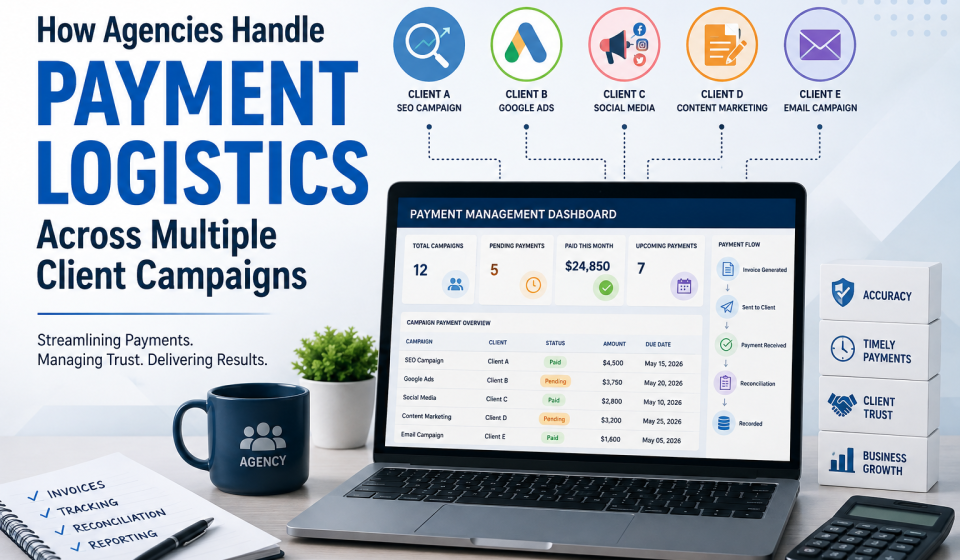

Running paid campaigns for one brand is a marketing job. Running them for fifteen brands at once is a logistics job that happens to involve marketing. Anyone who’s worked at an agency knows the part nobody warns you about: keeping the money straight. Which client paid for which spend, which card backs which account, and how to bill it all back accurately at the end of the month without a spreadsheet that looks like a ransom note.
Table Of Content
Payment logistics is one of those things that doesn’t scale gracefully. It works fine with two clients and quietly becomes a part-time job for someone by the time you hit ten. Here’s how agencies that have solved it actually handle the problem.
The mess of the shared-card approach
The default starting point for most agencies is a small set of shared cards. A couple of corporate numbers get used across every client’s ad accounts, and the team relies on careful note-keeping to remember what belongs to whom. It works until it doesn’t.
The failure modes are predictable. A card gets flagged because it’s running spend across too many accounts, and suddenly several clients’ campaigns freeze at once. Reconciliation at month-end turns into forensic accounting because one card’s statement blends a dozen clients together. And client billing gets murky, which is the last thing you want when you’re trying to prove exactly where a retainer went. Shared cards turn the agency’s payment layer into a shared point of failure for every client at the same time.
The fix: one card per client, or per campaign
The agencies that have this handled stop sharing cards entirely. Instead they issue a dedicated payment card for each client — or each campaign — so that everything is isolated from the start. Client A’s spend runs on Client A’s cards and nowhere else. When a card has a problem, exactly one client is affected, and the rest of the book keeps running.
This is where virtual cards have changed the game for agencies. Issuing a separate card per client used to be impractical; now it’s routine. Tools like virtual cards for ad spend let an agency spin up dedicated, limited cards for each client account, which makes the whole logistics problem mostly disappear. Spend is isolated, limits are enforced per client, and every transaction already carries the context of which client it belongs to.
Billing becomes trivial
The downstream benefit agencies notice fastest is billing. When each client’s spend lives on its own cards, the month-end statement basically writes itself. There’s no untangling, no guessing, no awkward conversation about a charge that might have been client B’s. You can show each client precisely what their campaigns cost because the payment structure mirrors the client structure. That clarity is also a trust mechanism — clients who can see exactly where their money went tend to stick around.
The funding layer
For agencies working with international clients or running spend across regions, funding adds another wrinkle. Crypto-funded cards have become a practical option here: maintain a balance topped up with crypto and issue client cards against it, sidestepping the slow cross-border settlement that traditional transfers drag in. It keeps cards funded and ready regardless of where the client or the campaign sits.
The bottom line for agencies
Payment logistics will never be the exciting part of agency work, but it’s one of the clearest places to remove friction and look more professional doing it. Move from shared cards to a card-per-client model, isolate every client’s spend, and the month-end scramble mostly evaporates. The time that used to go into untangling statements goes back into the campaigns themselves — which is, after all, what clients are actually paying for.