

A rank-tracking script can work perfectly for one market and still produce misleading reports when expanded to twenty. The problem is rarely just request volume. A search collected through the wrong location, a slow response captured after a reporting deadline, or a consent page mistaken for a valid result can all distort the picture. Scaling SEO monitoring means preserving the meaning of each observation as the system grows.
Table Of Content
- Define What a Ranking Observation Actually Means
- Separate Scheduling, Collection, and Interpretation
- Geolocation Is a Validation Problem
- Match the location to the business question
- Keep request signals consistent
- Validate the returned experience
- Choose Routes by Workload
- Plan for Latency Across the Entire Job
- Estimate capacity before increasing concurrency
- Place workers near the routes they use
- Retry Failures Without Creating More Failures
- Make Data Quality Visible in the Dashboard
- Extend Monitoring to AI Search Visibility Carefully
- Roll Out With a Pilot That Can Fail
- FAQs
- What is the best proxy type for SEO monitoring?
- Does a dedicated proxy improve ranking accuracy?
- How can I reduce latency without losing geographic accuracy?
- Why do rank trackers disagree with Search Console?
- Should failed searches count as ranking losses?
- Can a proxy guarantee AI citations or Google indexing?
Proxy infrastructure is part of that measurement process. Socks5.IO offers rotating residential, static residential, and datacenter options, giving teams different ways to handle regional checks and workflows that require a stable outbound address. The useful question is which route produces valid observations for a particular keyword, market, and reporting window.
Choosing a dedicated proxy for seo ranking makes sense when a monitoring application requires IP allowlisting or a predictable connection identity. It is less useful as a blanket choice for every collection job. Independent regional checks, recurring tool sessions, and technical website audits have different requirements. A reliable pipeline makes those differences explicit before adding more workers.
Define What a Ranking Observation Actually Means
“Track this keyword” is an incomplete specification.
A usable monitoring job needs a search engine, query, location, language, device profile, collection window, and result depth. It also needs a definition of position. The third organic listing is not necessarily the third visible item on a page containing ads, a local pack, videos, and an AI-generated answer.
Consider a company tracking “commercial cleaning services” in Manchester and London. Combining those observations into one UK ranking can conceal a local visibility problem. Comparing a desktop observation from Monday with a mobile observation from Tuesday introduces another variable.
Use a measurement key such as:
query + engine + requested_location + language + device + scheduled_window
Attach collection details to that key, including the observed location, route type, parser version, response status, and capture time.
This gives analysts a defensible unit of comparison. It also prevents the reporting layer from treating different searches as equivalent merely because their keyword text matches.
Keep first-party performance data alongside these observations. Google Search Console reports impressions, clicks, and position for your own property. External SERP monitoring adds controlled snapshots and competitor context. Differences between the two deserve investigation because they measure different populations and conditions.
Separate Scheduling, Collection, and Interpretation
A single process that schedules requests, fetches pages, parses results, and updates dashboards becomes difficult to repair. One unexpected page layout can interrupt unrelated work.
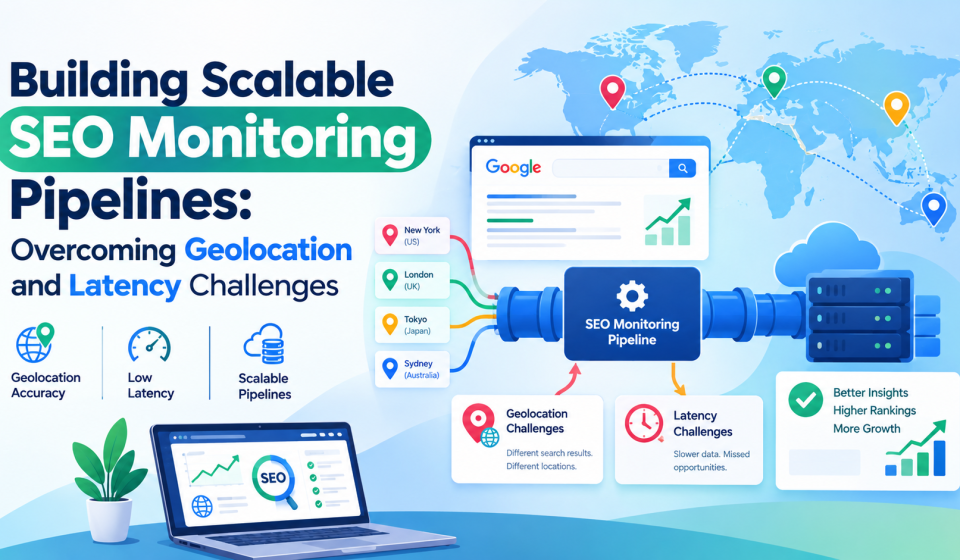
A more maintainable design has six stages:
- Scheduler: Creates jobs from keyword, market, and frequency settings.
- Queue: Holds pending work and distributes it across workers.
- Route selector: Assigns the appropriate location and session policy.
- Collector: Retrieves the response and records network diagnostics.
- Validator and parser: Determines whether the response is usable, then extracts results.
- Storage and reporting: Preserves observations and calculates comparable metrics.
Each stage should be replaceable without rebuilding the others.
For example, a parser update should allow historical responses to be reprocessed where retention permits. A proxy configuration change should not alter keyword identifiers. A failed dashboard refresh should not trigger another round of search requests.
Use idempotency keys so worker retries cannot create duplicate measurements. Record attempts separately from accepted observations: five collection attempts should not become five ranking samples.
Geolocation Is a Validation Problem
An endpoint labelled “London” is an input to the experiment. It does not prove the resulting page represents a London search.
Google’s documentation explains that search results can vary with location, language, device, and other context. An exit IP influences that context, but it does not reproduce every signal available to an actual user.
Three checks matter.
Match the location to the business question
Country-level monitoring may be sufficient for a national informational publisher. A dental group comparing local-pack visibility needs a more specific geographic model.
Do not collect at city level simply because the feature exists. More granular targeting can narrow available inventory and increase operational complexity. Use the smallest location unit that changes a business decision.
Likewise, a city proxy cannot establish exact street-level proximity. Reports for local businesses should explain that limitation.
Keep request signals consistent
Language settings, search parameters, cookies, device configuration, and IP location can pull in different directions.
A worker routed through France but carrying an English-language session established elsewhere may return a valid page that does not match the intended test.
Create explicit collection profiles. Set the intended language, isolate cookies between independent tests, and record the device configuration. For browser-based checks, inspect timezone and geolocation permissions where relevant.
Mobile results do not inherently require a mobile carrier proxy. Device presentation and network type are separate variables.
Validate the returned experience
Check the page’s language, available location indicators, expected result modules, and response type. Where useful, compare the exit address against an independent IP-location database.
These signals can disagree. Preserve the disagreement instead of silently choosing the most convenient answer.
Mark uncertain observations as unverified and exclude them from precise local comparisons. A missing measurement is easier to explain than an apparently authoritative ranking collected from the wrong market.
Choose Routes by Workload
Different proxy types solve different operational problems.
| Workload | Suitable starting point | Why it fits | What to verify |
| Independent keyword checks across markets | Rotating residential routes | Regional routing without maintaining a fixed IP for every observation | Required locations, valid-result rate, bandwidth consumed |
| Allowlisted rank-tracking software | Dedicated or static residential IPs | Predictable outbound address | Exclusivity, replacement policy, location availability |
| Multi-step collection session | Sticky residential session | Keeps related requests on a consistent route | Session duration and behavior after disconnection |
| Audits of websites you control | Direct or datacenter routes | Often economical for predictable technical checks | Server permissions, rate limits, regional requirements |
| Structured SERP collection with limited engineering capacity | Managed SERP API | Reduces collection and parsing maintenance | Supported markets, modules, freshness, provenance |
Socks5.IO’s mix of rotating and static products is relevant here because an SEO team may need both regional sampling and stable tool connections. Its published residential offering includes geographic targeting and session controls, while its integration examples support HTTP(S) and SOCKS5 workflows.
Those capabilities simplify integration, but compatibility still needs testing in the actual client. SOCKS5 support does not automatically mean remote DNS resolution, application-wide routing, or encrypted transport. Confirm those behaviors separately.
Avoid selecting a provider from advertised pool size alone. A large global network says little about usable capacity in the specific city your Monday report depends on.
Plan for Latency Across the Entire Job
Network response time is only one part of reporting delay.
A job can wait in a queue, spend time establishing a proxy connection, receive a slow response, require rendering, and then wait for parsing or storage. Improving the fastest stage may barely affect the final deadline.
Measure:
- Queue waiting time.
- Proxy connection and TLS setup time.
- Time to first byte.
- Download or rendering duration.
- Validation and parsing time.
- Total time from scheduling to accepted observation.
Track median and P95 values by market and route. A healthy global average can conceal one region that consistently misses its reporting window.
Estimate capacity before increasing concurrency
Suppose a monitoring program covers:
- 10,000 keywords.
- 12 locations.
- Two device profiles.
- One daily collection.
That creates 240,000 planned observations. With an illustrative 15% allowance for additional attempts, the workload becomes 276,000 attempts.
Completing that workload in six hours requires approximately 12.8 attempts per second. If each attempt occupies a worker slot for an average of eight seconds, the theoretical requirement is about 103 concurrent slots:
276,000 ÷ 21,600 seconds × 8 seconds ≈ 103
Operating around 70% utilization would suggest roughly 150 slots as an initial planning estimate.
This is a sizing illustration, not a recommended request rate. Actual limits depend on permitted access, provider constraints, response variability, browser resource use, and the target service’s policies.
Place workers near the routes they use
Sending every regional request through one distant worker cluster adds avoidable travel time.
Test regional worker placement and proxy gateway choices where available. Measure the complete path: worker to proxy, proxy to destination, and response back to the worker.
Choose configurations by valid observations delivered within the deadline. A short connection time has little value if the route returns the wrong market.
Retry Failures Without Creating More Failures
Retries help with temporary network problems. They can also turn a small incident into a queue backlog.
Classify failures before deciding what to do next:
- Connection timeout: Retry within a bounded budget.
- Authentication failure: Stop and flag configuration or credentials.
- Rate-limit response: Honor retry guidance and reduce pressure.
- Consent or challenge page: Mark the observation unavailable; review the collection method.
- Unexpected page structure: Preserve a sample and investigate the parser.
- Wrong location: Reject the observation and inspect routing.
Use exponential backoff with jitter for eligible transient failures. Set a maximum attempt count and a job deadline.
Circuit breakers should act on specific routes or markets when possible. If one regional endpoint deteriorates, healthy queues should continue processing.
Do not silently substitute another city to make a report appear complete. If broader geographic fallback is acceptable, define it in advance and label the resulting observation.
Make Data Quality Visible in the Dashboard
An HTTP 200 response is not proof of a successful rank check. Consent pages, error templates, and incomplete documents can all arrive with a successful status code.
Accept an observation only after it passes relevant checks: expected page type, intended context, parseable result structure, and sufficient evidence for the requested measurement.
Distinguish three outcomes:
- Found: The tracked domain appears within the collected result depth.
- Not found within depth: Collection succeeded, but the domain was absent.
- Unavailable: Collection or validation failed.
Converting “unavailable” into “not ranking” creates false alerts.
The operational dashboard should show valid-observation rate, wrong-location rate, parser failures, observation age, and on-time completion by market. Include a small, reviewed sample of captured results to catch errors that automated rules miss.
For cost control, calculate:
Cost per 1,000 valid observations = total attributable cost ÷ valid observations × 1,000
Include proxy traffic, API charges, compute, storage, and maintenance effort. Socks5.IO’s bandwidth-based rotating products and per-IP static options allow different cost models, but the cheaper choice depends on workload utilization and failure rates. Verify current terms rather than relying on a headline unit price.
Extend Monitoring to AI Search Visibility Carefully
Generative engine optimization adds another measurement problem: an AI answer can mention a brand without citing its website, cite a page without recommending the company, or omit the answer module entirely.
Track these events separately:
| Observation | What it establishes |
| Brand mention | The brand appeared in the captured answer |
| Source citation | A particular URL was attributed or linked |
| Recommendation | The answer explicitly presented the brand as an option |
| Answer-module presence | The monitored interface displayed an AI answer |
| Repeated appearance | Visibility persisted across the defined sample |
Record the prompt or query, interface, market, capture time, answer text where permitted, and cited URLs. Keep engine-specific results separate because interfaces and retrieval systems differ.
A single captured answer is a sample, not a universal “AI ranking.” Use repeated observations and disclose the sampling method.
Google’s guidance on AI features says established SEO practices remain relevant; there is no special markup that guarantees inclusion. Clear explanations, accessible pages, identifiable sources, and supported claims help readers evaluate content. They do not guarantee indexing or citation.
The monitoring pipeline should reflect that same standard: every visibility claim should lead back to a recorded observation.
Roll Out With a Pilot That Can Fail
Begin with a representative keyword set covering branded, informational, commercial, and local intent. Include important markets and a few locations likely to expose inventory or latency problems.
Define acceptance criteria before testing: geographic validity, completion deadline, parser accuracy, and cost per valid observation.
Run competing configurations against equivalent workloads over several collection windows. Review uncertain results manually. Expand only after the pipeline produces explainable measurements.
A successful pilot may reveal that some jobs need stable IPs, others need rotating routes, and a third group is cheaper through a managed API. That is a useful outcome. Scalable SEO monitoring comes from matching infrastructure to the measurement, then preserving that measurement as volume grows.
FAQs
What is the best proxy type for SEO monitoring?
Rotating residential proxies are a reasonable starting point for independent regional checks. Static or dedicated IPs suit allowlisted tools and stable connections. Compare them using geographic validity, completion time, and cost per valid observation.
Does a dedicated proxy improve ranking accuracy?
A dedicated address provides a predictable route. Accuracy still depends on location, language, device settings, session context, collection timing, and parsing. A fixed IP in the wrong market produces a consistent but unsuitable measurement.
How can I reduce latency without losing geographic accuracy?
Measure each stage, test regional worker placement, limit unnecessary rendering, and tune concurrency by market. Keep geographic validation active while optimizing speed.
Why do rank trackers disagree with Search Console?
Trackers capture selected searches under defined conditions. Search Console aggregates real impressions across users, devices, locations, and time. Compare trends with those differences in mind.
Should failed searches count as ranking losses?
No. Failed collection should be reported as unavailable. Report “not found within depth” only after validating that collection succeeded.
Can a proxy guarantee AI citations or Google indexing?
No. Proxies support collection and regional observation. Indexing and citation depend on the publishing site, content, accessibility, relevance, and the search system’s decisions.