

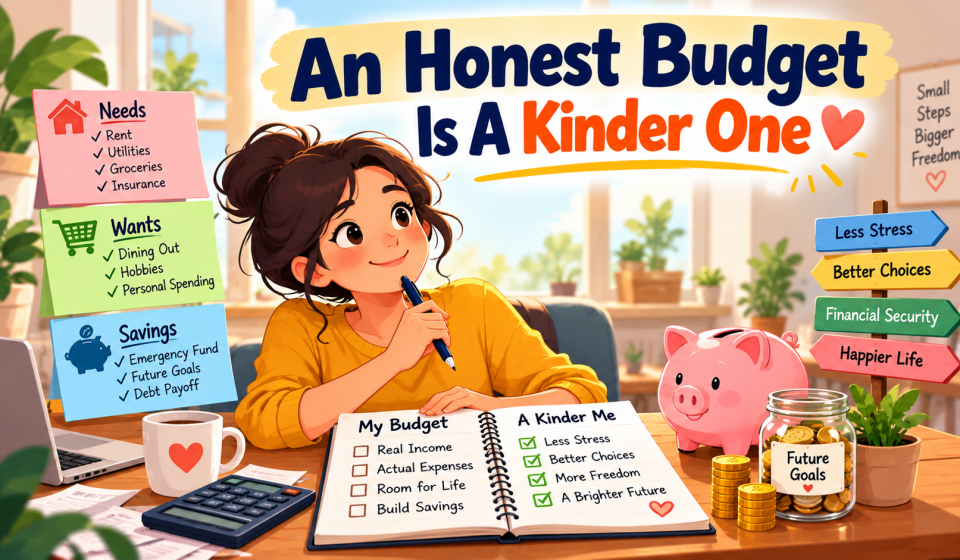

An honest budget is kinder when it tells the truth about your real life, not the life you wish you were living on your most disciplined Tuesday. A lot of budgets fail because they are written like correction slips. They punish coffee, erase fun, and pretend every month will be calm and predictable. Then one busy week, one school expense, or one dinner out knocks the whole plan over.
A kinder budget starts from a less flattering but more useful place. It assumes you are human. It expects some friction, some emotion, and some uneven spending. That does not make it soft. It makes it accurate. The Consumer Financial Protection Bureau describes budgeting as a way to cover needs and wants while still building savings, and it also offers tools built around sorting spending into those categories.
This matters even more when money is already tight and every choice feels loaded. If someone is comparing options like cutting a bill, delaying a purchase, or researching title loans in Tyler, TX, the most useful budget is the one that shows the truth clearly. Not the prettiest version of the month, but the version that helps you decide what can bend and what cannot.
A budget is not a morality test
Many people quietly treat budgets like report cards. If they overspend in one category, they feel they failed. That feeling can make them stop looking at the numbers altogether. The American Psychological Association notes that money is a major source of stress for many adults, and financial denial can make the problem harder to manage.
A kinder budget does something different. It separates information from shame. If groceries are higher than expected, that is information. If gas jumped, that is information. If your so called fun money keeps getting spent on convenience food during exhausting weeks, that is also information. None of it means you are careless. It means your budget needs to reflect how your days actually work.
That shift matters because shame produces fantasy budgets. Fantasy budgets are full of categories that look responsible and amounts you have never once maintained. Honest budgets are built from bank statements, receipts, bills, and patterns. They may be less impressive on paper, but they are far more useful.
Leave room for real behavior
A strict plan often breaks because it leaves no space for ordinary life. A kind budget includes categories that people tend to erase, such as quick meals, birthday gifts, school events, pet care, and a small amount of personal spending. These are not always emergencies. They are recurring parts of being alive.
This is also where broad formulas can help without becoming rigid law. The CFPB shares versions of the 50 30 20 framework as one way to think about needs, wants, and savings goals. That can be a starting point, not a verdict. If your rent is high, your percentages may look different for a while. If your income changes week to week, you may need a budget based on your lowest normal month, with better months used to catch up, save, or pay down debt.
Build a plan for tired decisions
One overlooked reason budgets unravel is exhaustion. When people are stressed and underslept, it gets harder to think clearly. The National Institutes of Health explains that poor sleep can affect decision making, problem solving, emotions, and behavior. NIH guidance on how poor sleep affects judgment and decision making
That has practical consequences for money. If you make your budget as if every purchase will be decided by your most rested and patient self, you are setting a trap. A kinder budget plans for tired decisions in advance.
- Keep one low effort meal option in the grocery plan.
- Set automatic transfers, even if the amount is small.
- Create a short list of bills that must always be covered first.
- Give yourself a realistic weekly amount for flexible spending.
These are not shortcuts around discipline. They are supports for the moments when discipline is harder to access.
Use categories that help you choose
Some budgets are too detailed to guide real decisions. Twenty seven categories might look organized, but they can hide what matters. A kinder budget uses categories that answer useful questions fast.
- Fixed essentials: rent, utilities, insurance, minimum debt payments
- Variable essentials: groceries, gas, medications
- Flexible life spending: eating out, hobbies, small treats
- Future protection: savings, extra debt payments, emergency cushion
With this setup, if money gets tight, you can quickly see which area has room to adjust. That is the real purpose of a budget. It is not to prove virtue. It is to help you make tradeoffs on purpose.
An honest budget is easier to keep
People often assume the best budget is the most ambitious one. Usually, it is the one you can face without flinching. If your plan includes enough truth to survive a hard week, it is already doing more for you than a perfect spreadsheet you abandon by the tenth.