

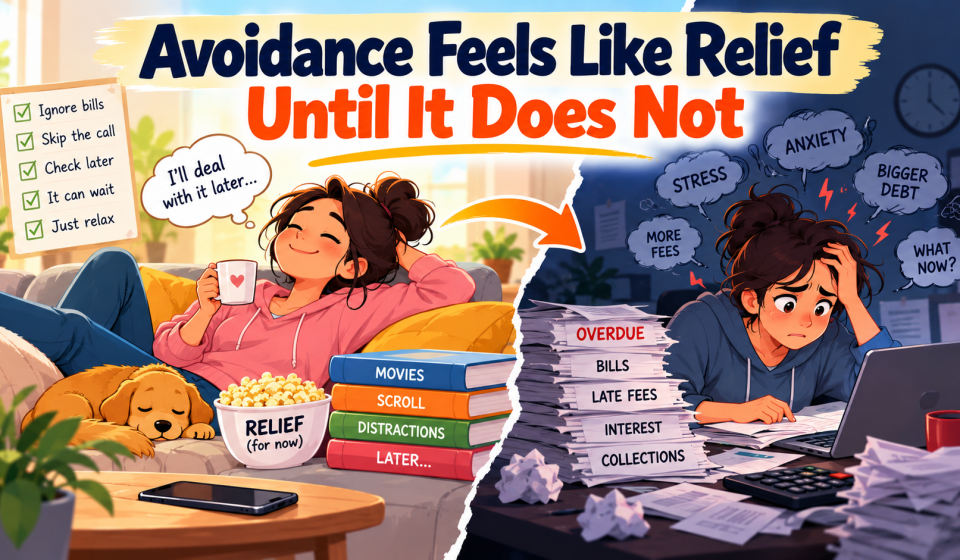

If Relief Is the Reward, Avoidance Starts to Look Smart
There is a reason people avoid hard money conversations, unopened bills, and account balances they already know will sting. Avoidance works, at least for a moment. You skip the call, swipe away the bank alert, promise yourself you will deal with it on Saturday, and your body calms down just enough to get through the day. That brief exhale can feel like proof that you made the right choice.
That is what makes financial avoidance so sneaky. It does not usually begin as laziness or irresponsibility. It begins as self protection. When debt feels loaded with shame, uncertainty, or fear, looking away seems like the fastest path back to normal. Sometimes that means putting off a budget review. Sometimes it means ignoring a creditor. Sometimes it means finally researching options, including a debt consolidation company, only after weeks or months of trying not to think about the problem at all.
The Brain Loves Quick Relief, Even When It Makes Tomorrow Harder
From a stress perspective, avoidance can train the brain in the worst possible way. If every time you dodge a stressful financial task you feel temporary relief, your mind starts linking avoidance with safety. The original problem, whether it is debt, a missed payment, or a stack of overdue notices, begins to feel even more threatening the next time it appears. Psychologists describe avoidance coping as turning away from threatening information instead of dealing with it directly. The strategy can reduce distress in the short term, but it also keeps the fear cycle alive.
This is why small financial tasks can start to feel weirdly enormous. A ten minute phone call becomes an all day dread event. Checking one statement feels harder than cleaning the entire kitchen. The issue is not just the debt itself. It is the learned emotional charge around it. The more often you escape that feeling by not acting, the more intimidating the task becomes.
Debt Problems Grow in the Dark
Money issues rarely stay frozen while you gather the courage to face them. Interest keeps accruing. Late fees may stack up. Collection activity may continue. The Consumer Financial Protection Bureau warns that ignoring or avoiding a debt collector is unlikely to make the contact stop, and it also explains that acting quickly when you cannot pay credit card bills can open the door to hardship options, counseling, or other workable next steps. Consumer guidance on debt collection and NIMH information on anxiety disorders both point to a similar truth in different settings: fear tends to expand when people keep retreating from the thing that scares them.
That is the real cost of avoidance. It does not just risk a larger balance. It can shrink your sense of capability. You stop trusting yourself to handle ordinary admin tasks. You become more reactive, more ashamed, and more likely to make rushed choices once the pressure gets high enough. In that state, even decent solutions can feel suspicious, and bad solutions can look tempting simply because they promise immediate relief.
Why Smart People Avoid Obvious Problems
A lot of people assume that if a problem is serious enough, motivation should automatically kick in. Real life does not work that way. Stress narrows attention. Scarcity does too. When money is tight, the brain often focuses on whatever is most urgent right now, such as groceries, rent, or getting through work this week. Long term planning starts to feel abstract, even if you know it matters.
That helps explain why capable people can be deeply avoidant about finances while being highly functional in other parts of life. They are not confused about the math. They are flooded by the meaning attached to the math. Debt can stir up identity issues fast. It can whisper that you are careless, behind, or failing at adulthood. Once that story takes over, opening an account is no longer just opening an account. It feels like walking into judgment.
The Way Out Is Usually Smaller Than You Think
People often wait to take action until they feel brave, organized, or fully informed. That sounds sensible, but it can become another form of avoidance. In many cases, action needs to come first, and confidence catches up later.
The first useful move is not solving everything. It is breaking the fear loop. That might mean listing every account on one page. It might mean calling one creditor instead of all of them. It might mean setting a fifteen minute timer and looking at balances without making any decisions yet. The goal is to teach your brain a new lesson: contact with the problem is uncomfortable, but not dangerous.
This matters because momentum usually follows exposure. Once the mystery is gone, the numbers may still be stressful, but they stop shape shifting in the dark. You can compare options, ask better questions, and make decisions from a calmer place.
Relief That Lasts Feels Different
Avoidance offers a fast drop in tension, but it is flimsy relief. It expires quickly, and the problem is still waiting for you, usually a little larger than before. Lasting relief has a different texture. It may arrive with discomfort at first, because real relief is built through contact, clarity, and repetition.
That can look boring from the outside. Returning a call. Reading the fine print. Asking for hardship assistance. Getting professional guidance. Making a payment plan you can actually sustain. None of that produces the instant emotional payoff of pretending the issue does not exist. What it does produce is something better: a life that does not keep getting smaller around one avoided problem.
If avoidance has been your go to strategy, that does not mean you are weak. It means your nervous system found a shortcut. The trouble is that shortcuts sometimes lead in circles. The way forward is not to shame yourself for avoiding. It is to notice the pattern, interrupt it with one concrete step, and let that step become evidence. You can face the thing. You can stay in the room. And once you do, relief stops being a temporary escape and starts becoming a real change.