
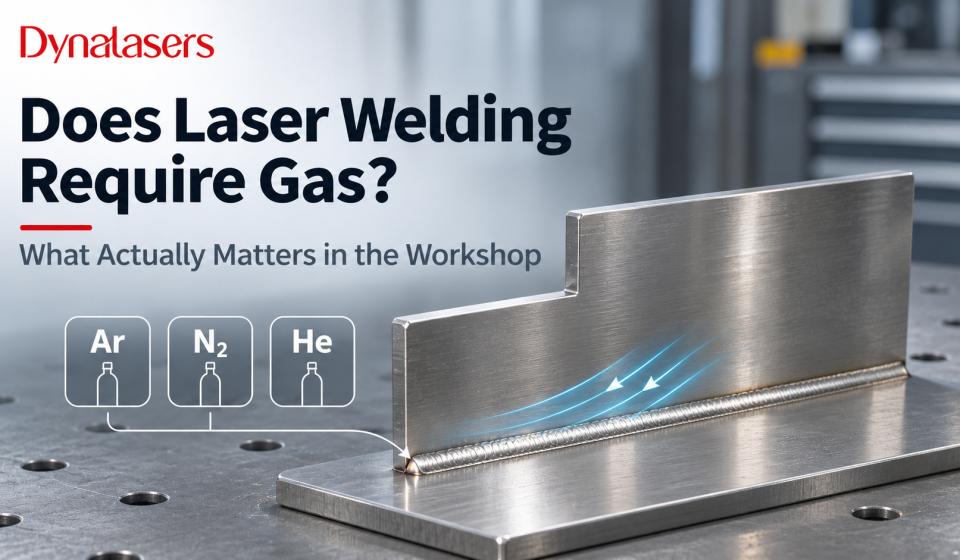

Does laser welding require gas? Not always. A laser can melt and join metal without external shielding gas, but that doesn’t mean gas-free welding is suitable for every job. On stainless steel, aluminum, or production parts where surface quality matters, poor shielding can lead to oxidation, discoloration, and inconsistent results.
Table Of Content
- Why Is Shielding Gas Used in Laser Welding?
- Can You Perform Laser Welding Without Shielding Gas?
- Argon vs. Nitrogen vs. Helium: Which Shielding Gas Is Best?
- Can One Shielding Gas Work for Multiple Metals?
- How Much Shielding Gas Does Laser Welding Need?
- Common Shielding Gas Problems and How to Fix Them
- Dynalasers S, M, and D Series: Shielding Gas Considerations
- S Series: Compact Welding Applications
- M Series: Flexible Industrial Fabrication
- D Series: Integrated Workshop Welding
- Frequently Asked Questions
- Can Flux-Cored Wire Replace Shielding Gas in Laser Welding?
- Does Stainless Steel Pipe Laser Welding Need Back Purging?
- Can Compressed Air Replace Argon During Laser Welding?
- Conclusion
For workshops using handheld systems such as the Dynalasers S, M, and D Series, the choice of gas is part of setting up the welding process. The material, joint design, nozzle position, and workshop conditions all influence how much shielding is needed.
Why Is Shielding Gas Used in Laser Welding?
The main job of shielding gas for laser welding is to keep surrounding air away from the molten weld pool. Oxygen, moisture, and, in some alloys, nitrogen can affect the weld as the metal melts and solidifies.
Gas also has other functions that are worth separating.
| Function | Effect on Welding |
| Atmospheric Protection | Limits oxidation and unwanted gas absorption |
| Weld Appearance | Helps maintain a cleaner, more consistent surface |
| Weld Quality | Can reduce certain gas-related defects |
| Plume Control | Helps move metal vapor away from the beam path |
At higher power densities, vaporized metal forms a plume above the weld. Gas flow can help manage this plume, although its behavior varies with the laser wavelength and processing conditions.
Shielding the molten metal and protecting the optics are two different tasks. Some systems use a separate air cross-jet to keep debris away from optical components. That airflow should not be mistaken for suitable shielding around the weld pool.
Even with good gas coverage, porosity can still occur if the material is contaminated or the welding parameters produce an unstable molten pool.
Can You Perform Laser Welding Without Shielding Gas?
Laser welding without shielding gas is possible in certain industrial applications. Whether it works depends on the metal, processing conditions, and what the finished joint is expected to withstand.
For example, a mild steel component with limited cosmetic requirements may be a candidate for gas-free welding trials. A brushed stainless steel panel or aluminum housing often needs more careful atmospheric protection, particularly where surface finish or corrosion performance matters.
Titanium presents a different challenge. Because it reacts readily with atmospheric gases at elevated temperatures, effective shielding during welding and cooling is particularly important.
The term gasless laser welding machine can also be misleading. It may describe a machine that operates without an external gas supply, but it says nothing about whether the resulting weld meets a particular quality requirement.
For production work, removing shielding gas should be treated as a process change. Representative samples need to be tested before the revised setup is approved.
Argon vs. Nitrogen vs. Helium: Which Shielding Gas Is Best?
There isn’t one laser welding shielding gas that works equally well for every metal. Argon, nitrogen, and helium behave differently, and choosing between them involves both material compatibility and operating cost.
| Gas | Main Advantage | What to Consider |
| Argon (Ar) | Inert and suitable for many common metals | Not always the best option for every process |
| Nitrogen (N₂) | Often economical for selected steel applications | Nitrogen absorption can affect certain alloys |
| Helium (He) | Useful thermal and ionization properties | Higher cost and different delivery requirements |
| Ar/He Mixtures | Allows gas properties to be adjusted | Results depend on the application |
Argon is often the simplest starting point for a workshop processing stainless steel, carbon steel, and aluminum. It is widely available and chemically inert, although the welding parameters still need to be adjusted for each material.
Nitrogen can be useful in certain stainless steel applications. In a published study using 304 stainless steel and a 5 kW fiber laser, nitrogen shielding reduced keyhole-related porosity under the tested conditions. The weld metal also absorbed additional nitrogen; with pure nitrogen shielding, its measured nitrogen content was approximately 36% higher than that of the base metal.
That result is specific to the investigated material and process. It does, however, show why nitrogen for laser welding needs to be evaluated against the requirements of the actual alloy.
Can One Shielding Gas Work for Multiple Metals?
Keeping one gas supply for several materials is convenient, especially for smaller fabrication shops.
An 80% argon / 20% helium mixture, for instance, may sound like a practical compromise. However, adding helium does not guarantee deeper penetration or better weld quality on every metal. Its effect depends on the material, laser characteristics, and how the gas is delivered.
For a workshop handling occasional jobs in several metals, starting with argon and checking the weld results is often more practical than investing in a special mixture without application-specific evidence.
How Much Shielding Gas Does Laser Welding Need?
The correct laser welding gas flow rate depends on more than the number displayed on a flowmeter. Nozzle geometry, distance from the joint, gas type, and surrounding airflow determine how effectively the molten metal is protected.
Dynalasers provides the following starting recommendations for its handheld welding equipment:
| Application | Suggested Gas Flow |
| General metal welding | 12–18 L/min |
| Aluminum welding | 18–25 L/min |
These are manufacturer-recommended starting ranges, not fixed values for every nozzle or welding condition.
Gas consumption is straightforward to estimate:
Gas Consumption (L) = Flow Rate (L/min) × Gas-On Time (min)
At 15 L/min, a machine delivering gas for 30 minutes uses approximately 450 L, or 0.45 m³.
That calculation uses gas-on time, which may differ from actual welding time. Pre-flow, post-flow, and gas delivery during standby can increase total consumption.
Higher flow is not necessarily better. If the nozzle sits too far from the workpiece, or nearby ventilation pulls the shielding stream sideways, the weld may still be exposed to air. Excessive gas velocity can also create turbulence and draw surrounding air into the protected area.
Before increasing the flow, check whether the gas is reaching the joint properly.
Common Shielding Gas Problems and How to Fix Them
A dark weld or a few visible pores don’t automatically mean the operator needs more shielding gas. Material condition, joint preparation, and laser settings can produce similar problems.
The first checks should be based on the defect actually observed.
| Problem | Possible Causes | What to Check |
| Black or Discolored Weld | Poor gas coverage, drafts, contamination | Nozzle position, airflow, surface cleanliness |
| Porosity | Moisture, contamination, unstable keyhole | Material preparation, shielding, process settings |
| Excessive Spatter | Unstable energy input or poor fit-up | Power, travel speed, focus, joint condition |
| Inconsistent Bead | Variable gas coverage or movement | Nozzle alignment, gas supply, operator technique |
Consider a stainless steel weld that looks clean at the beginning but becomes darker toward the end. If the gas supply remains stable, the problem might be a changing nozzle angle or airflow disturbing the shielding stream.
Increasing flow may not help. The better approach is to repeat the joint under controlled conditions, check the gas coverage, and compare the results before changing other parameters.
Oil, moisture, coatings, and oxide layers should also be investigated when porosity persists. A different shielding gas won’t compensate for poor material preparation.
Dynalasers S, M, and D Series: Shielding Gas Considerations
Dynalasers offers several handheld welding machines that support common process gases, including argon, nitrogen, and helium. Gas selection depends primarily on the materials being joined, while machine layout influences how easily the operator can maintain consistent coverage.
S Series: Compact Welding Applications
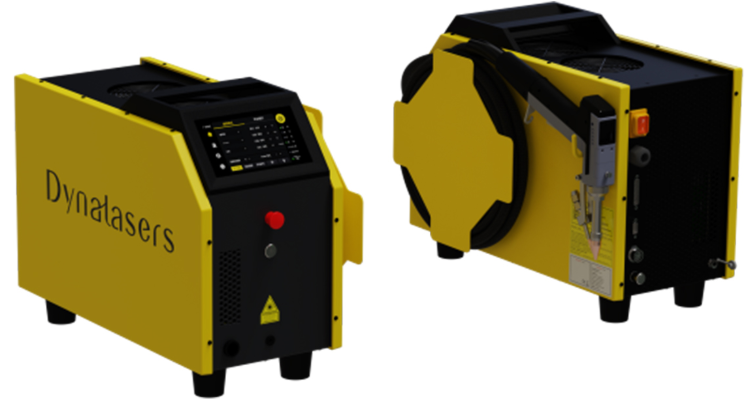
The S Series includes S10 Spot, S30, and S40, designed for compact and localized welding tasks. When working with smaller components or narrow joints, nozzle access can become a practical limitation. The shielding stream needs to reach the weld even when the operator changes position.
M Series: Flexible Industrial Fabrication
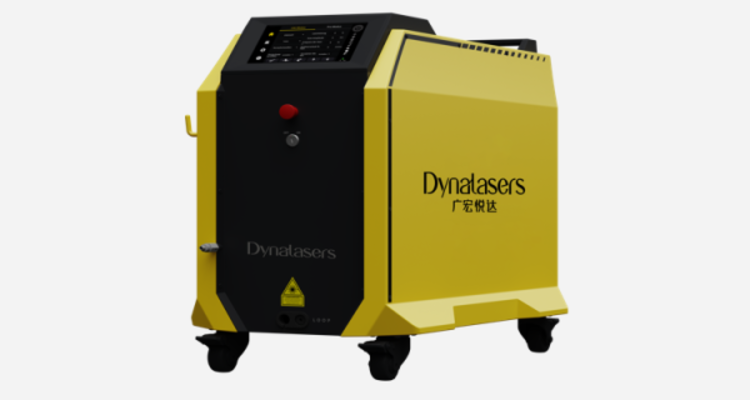
The M Series covers M30, M50, M70, and M71. The M71 is an 1800W five-in-one energy-storage welding system featuring dual wobble, seven scanning patterns, and single- or dual-wire feeding.
For wire-fed applications, gas selection should account for both the base material and filler metal. If a machine is moved between workstations, nozzle position, gas connections, and local airflow should be checked before welding resumes.
D Series: Integrated Workshop Welding
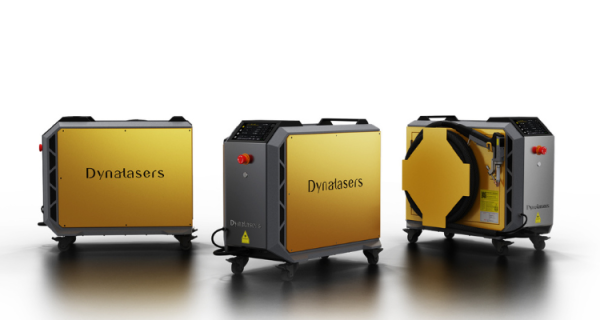
The D Series includes the D50P (1200W) and D70P (1800W), both using integrated air-cooled configurations.
Their design can simplify equipment placement, although the workshop still needs suitable gas-cylinder storage, regulators, hose routing, and ventilation. An integrated machine does not automatically reduce shielding gas consumption.
Frequently Asked Questions
Can Flux-Cored Wire Replace Shielding Gas in Laser Welding?
Not as a direct substitute. Self-shielded flux-cored arc welding uses consumables designed to produce protective gases and slag during an arc-welding process. Standard handheld laser welding equipment is not automatically compatible with that approach. Any proposed use of flux-cored wire would require specific equipment checks and process qualification.
Does Stainless Steel Pipe Laser Welding Need Back Purging?
It depends on the joint and service requirements. When a full-penetration stainless steel pipe weld requires a corrosion-resistant root surface, internal gas protection may be necessary. Shielding from the outside does not always prevent oxidation on the inside of the pipe.
Can Compressed Air Replace Argon During Laser Welding?
Not as a general substitute. Compressed air contains oxygen and nitrogen and may also contain moisture. It can serve certain optical-protection or plume-control functions, but these are different from providing an inert atmosphere around the molten weld pool. Any air-based process needs to be qualified for the intended material and joint.
Conclusion
Does laser welding require gas? Not for every application. Still, most handheld welding jobs benefit from proper shielding, especially when weld appearance and consistency matter.
For workshops using Dynalasers S, M, or D Series equipment, a sensible starting point is to select a gas compatible with the material, establish stable coverage, and check the weld results before moving into production.