

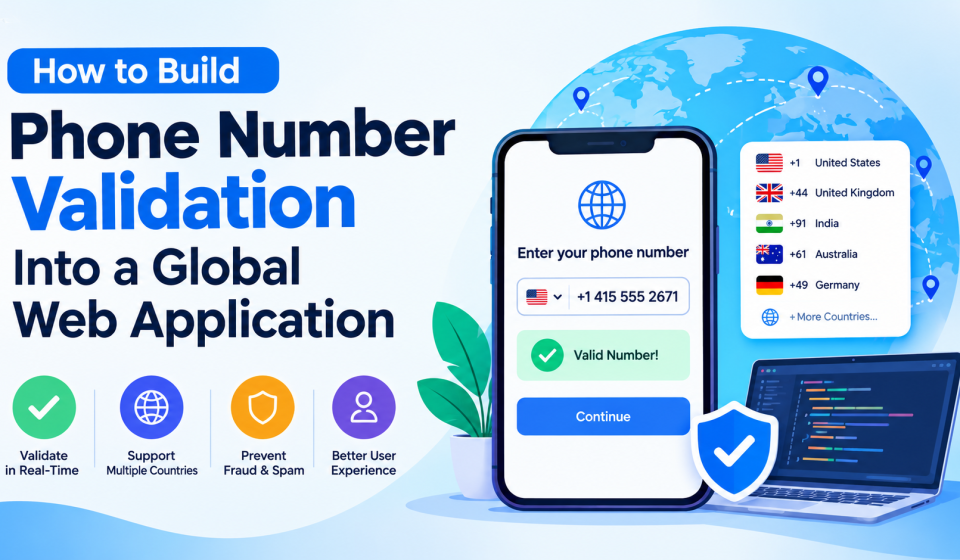

Phone number validation isn’t always simple when your web application starts serving users in multiple countries. A number that looks valid in one market may be impossible in another, while formatting conventions vary widely by region, carrier, and device. If your product depends on account creation, two-factor authentication, delivery updates, sales outreach, or customer support, getting phone number validation right is essential for both user experience and operational reliability.
Global applications need to handle phone numbers as structured data, not just strings of digits. Product teams often ask, how do I implement phone number verification that works across international markets? The answer is to combine strong input design, international parsing standards, carrier-aware validation, and a verification workflow that confirms the user actually controls the number. Here’s how to build that kind of structure into a global web application:
Understand the Difference Between Validation and Verification
Validation checks whether a phone number is plausible or valid according to numbering rules. For example, it can determine whether the country code exists, whether the number has the right length, and whether the prefix is assigned to a mobile, landline, toll-free, or VoIP service.
Verification goes a step further. It confirms that the user has access to the number, usually by sending a one-time passcode via SMS, voice call, or messaging app. A number can be valid but still not belong to the user entering it. For sensitive actions such as account recovery, payments, or two-factor authentication, validation alone is not enough.
Use International Number Standards
The most important standard for global phone numbers is E.164. It represents numbers with a plus sign, country code, and subscriber number, such as `+14155552671`. Storing numbers in E.164 format makes your database consistent and reduces ambiguity.
Avoid storing phone numbers only in local formats such as `(415) 555-2671` or `020 7946 0958`. These formats are useful for display, but they are not reliable for processing. A good approach is to accept user-friendly input, parse it into a normalized E.164 value, and then display it back in the user’s local format when needed.
Libraries such as Google’s libphonenumber can help parse, format, and validate numbers for many regions. They are widely used and regularly updated, which is important because numbering plans change over time.
Design Input Forms for Global Users
A global phone number field should not assume every user has a US-style 10-digit number. Split the country selection from the local number field, or use a single international input that supports country codes clearly. Many applications use a country dropdown with flags and dialing codes, but you should not rely on flags alone, since countries and territories can share complex dialing relationships.
Preselecting the country based on locale, shipping address, IP location, or browser settings can reduce friction, but always allow the user to change it. Users may travel, use foreign SIM cards, or manage accounts for businesses in other countries.
Also, avoid overly restrictive client-side masks. Formatting masks can help users enter numbers correctly, but if they block legitimate international formats, they create unnecessary failures. Let the backend perform authoritative validation.
Validate on Both Client and Server
Client-side validation improves the user experience by catching obvious mistakes immediately, such as missing country codes or invalid characters. However, client-side checks can be bypassed, so server-side validation is required.
On the server, parse the number using the selected country context, normalize it to E.164, and check whether it is possible and valid for that region. If your use case depends on SMS delivery, also determine the line type when possible. Sending SMS codes to landlines, premium-rate numbers, or unsupported VoIP numbers can increase costs and create failed verification attempts.
Your validation logic should return clear, user-friendly errors. Instead of saying “Invalid input,” tell the user what to fix: “Enter a valid mobile number for Germany” or “This number cannot receive text messages.”
Build a Reliable Verification Flow
For verification, send a time-limited one-time code to the normalized number. Codes should expire quickly, typically within 5 to 10 minutes, and should be rate-limited to prevent abuse. Limit repeated sends to the same number, account, IP address, and device fingerprint.
Offer fallback channels when possible. SMS is common, but delivery can be inconsistent in some countries due to carrier filtering, roaming issues, or local regulations. Voice calls, WhatsApp, email backup, or authenticator apps may improve completion rates depending on your audience.
Do not reveal whether a phone number is already registered unless your product intentionally supports that behavior. Otherwise, attackers may use your form to enumerate user accounts.
Account for Compliance and Privacy
Phone numbers are personal data and may be regulated under laws such as GDPR, CCPA, and other regional privacy frameworks. Collect only what you need, explain why you need it, and protect it with encryption, access controls, and audit logging.
If you send marketing messages, transactional alerts, or authentication codes, understand local consent and messaging rules. Some countries require sender registration, approved templates, or specific opt-in language.
Monitor Performance by Country
After launch, track validation failures, verification completion rates, delivery delays, and cost by country and carrier. These metrics help you identify broken form assumptions, outdated metadata, or messaging routes that underperform in specific markets.
Building phone number validation into a global web application is not just a formatting task. It requires international standards, thoughtful UX, secure verification, and ongoing monitoring. Done well, it reduces fraud, improves deliverability, and gives users around the world a smoother path into your product.