

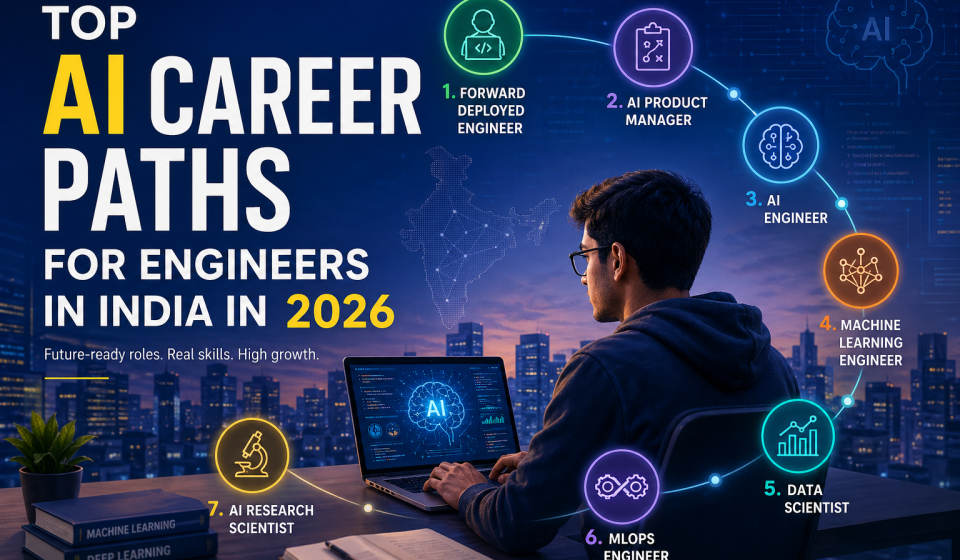

The AI job market in India is growing faster than most engineering graduates realise.
Table Of Content
But it is not growing uniformly. Specific roles are seeing explosive demand while others are becoming more competitive and harder to enter without differentiated skills. Picking the right path early makes a significant difference in where you land three to five years from now.
This article covers the most relevant AI career paths for engineers in India right now, what each one requires, and what the market is actually paying.
1. Forward Deployed Engineer
The fastest growing AI role in 2026 and the least understood by most engineering graduates.
A forward deployed engineer role sits at the intersection of software engineering, AI deployment, and direct business execution. FDEs work inside customer environments, take AI products, and make them function reliably within specific business constraints. They own outcomes, not just code.
The model was invented by Palantir and has since been adopted by Salesforce, Databricks, Atlassian, OpenAI, and hundreds of AI startups. Job postings for this role grew more than 800% in 2025.
What makes this role different from every other role on this list is the combination of skills it requires and rewards:
- Deep technical execution in Python, APIs, LLMs, and deployment pipelines
- Business problem translation from vague requirements to precise technical solutions
- Client communication across both technical and non-technical stakeholders
- Full production ownership from deployment to outcome
Salary range in India: 14 to 75 LPA. Senior FDEs at global AI companies command significantly higher packages.
The career exits from the FDE role are unusually broad. Engineers who spend two to three years in this role frequently move into Technical Program Manager, Solutions Architect, AI Product Manager, or startup founding roles.
2. AI Product Manager
Not a pure engineering role but one of the fastest growing career transitions for engineers who want to move toward product and strategy.
AI PMs own the vision, roadmap, and execution of AI-powered products. They work at the intersection of user needs, business goals, and technical feasibility. Unlike traditional PMs, they need a working understanding of how AI systems behave, where they fail, and what is realistically buildable.
Engineering backgrounds are a significant advantage here. Engineers who transition into AI product management bring technical credibility that pure business-side PMs often lack.
The role is distinct enough from traditional product management that dedicated AI product management course offerings have started appearing in India specifically to bridge that gap.
Salary range in India: 18 to 60 LPA depending on company and experience level.
3. AI Engineer
A newer and increasingly distinct role from the traditional ML engineer. The AI engineer works primarily with foundation models and large language models rather than building models from scratch.
Core work involves API integration, prompt engineering, RAG pipeline development, and connecting AI capabilities to real applications. The role is more systems-oriented than research-oriented.
This is where a large portion of current AI hiring is concentrated. Companies deploying AI products need engineers who can work fluently with existing models and make them function correctly in production environments.Engineers who have mapped out how to become an AI engineer in 2026 typically start with LLM fundamentals and API work before moving into RAG and agentic systems.
Salary range in India: 14 to 45 LPA. Growing fast as demand consistently outpaces supply.
4. Machine Learning Engineer
Still one of the most recognised AI roles and a strong entry point for engineers with a solid foundation in mathematics and programming.
ML engineers build, train, and optimise machine learning models. They work with large datasets, design model architectures, and collaborate with data teams to push models toward production readiness.
The role requires strong Python skills, familiarity with frameworks like TensorFlow and PyTorch, and a working understanding of statistics and linear algebra.
Salary range in India: 12 to 40 LPA depending on experience and company. The upper end is concentrated at product companies and AI-native startups.
The challenge with this role in 2026 is market saturation at the entry level. Bootcamps and online courses have produced a large supply of candidates with similar skill sets. Differentiating yourself requires either domain specialisation or deployment experience on top of the fundamentals.
5. Data Scientist
The role that attracted the most attention five years ago has matured significantly.
Data scientists build analytical models, extract insights from large datasets, and inform business decisions through quantitative analysis. The role sits closer to business intelligence than to AI engineering and requires strong statistical thinking alongside technical skills.
The market for data scientists in India is deep but competitive. Companies across banking, ecommerce, healthcare, and logistics hire consistently for this role.
Salary range in India: 10 to 35 LPA. Senior data scientists with domain expertise in finance or healthcare can reach significantly higher.
The most important career advice for aspiring data scientists in 2026 is to develop genuine domain expertise alongside technical skills. Generic data science profiles are harder to place than they were three years ago.
6. MLOps Engineer
The operational backbone of any serious AI deployment. MLOps engineers build and maintain the infrastructure that allows ML models to be trained, deployed, monitored, and updated reliably at scale.
The role requires strong DevOps fundamentals plus familiarity with ML pipelines, model versioning, and monitoring frameworks. Tools like MLflow, Kubeflow, and Airflow are standard.
As more companies move from AI experimentation to production deployment, MLOps has become a critical and well-compensated specialisation.
Salary range in India: 15 to 50 LPA. Demand is high and the pool of qualified candidates remains relatively small compared to ML engineering.
7. AI Research Scientist
The most academically intensive path on this list and the one with the highest ceiling and the highest barrier to entry.
AI research scientists work on advancing the fundamental capabilities of AI systems. They publish papers, run experiments, and push the boundaries of what models can do. Most positions at leading AI labs require a PhD or equivalent research experience.
In India, AI research roles are concentrated at large tech companies, IIT research labs, and the Indian operations of global AI companies.
Salary range in India: 20 to 80 LPA at research labs. The top end at global AI companies is significantly higher for exceptional researchers.
This path is right for engineers who are genuinely passionate about the science of AI, not just its applications.
How to Choose the right AI Career Path
No single path is objectively better. The right choice depends on what kind of work energises you and what career outcomes you are optimising for.
| If you want | Consider |
| Deep technical research | AI Research Scientist |
| Building AI systems end to end | AI Engineer or ML Engineer |
| Working with business and clients | Forward Deployed Engineer |
| Transitioning into product and strategy | AI Product Manager |
| Infrastructure and reliability work | MLOps Engineer |
| Data driven business decisions | Data Scientist |
The most important thing is to choose deliberately rather than defaulting to whichever role sounds most familiar. The AI job market in India in 2026 rewards specificity and genuine skill depth far more than it rewards generic profiles with broad but shallow exposure.