

Why are some business processes slower than expected even if employees are working efficiently? Delays are often not obvious, and there are often unnecessary activities and a lack of coordination between departments. Lean Six Sigma Training teaches professionals how they can discover inefficiencies in the processes and how to enhance business performance as a whole.
Table Of Content
All business processes have activities that result in the delivery of products or services. Some steps, however, consume resources but do not provide much value. Organisations can use Value Stream Mapping to see these activities and find opportunities for improvement. It also aids communication and informed decision-making. In this blog, let us explore how Value Stream Mapping identifies bottlenecks and improves business processes.
Table of Contents
- How Value Stream Mapping Helps Identify Bottlenecks in Business Processes
- Conclusion
How Value Stream Mapping Helps Identify Bottlenecks in Business Processes
Below are the key ways Value Stream Mapping helps businesses identify process bottlenecks, eliminate unnecessary activities and improve operational efficiency:
Provides a Clear View of Business Processes
When working with different teams and departments, it can be hard to understand an entire business process.
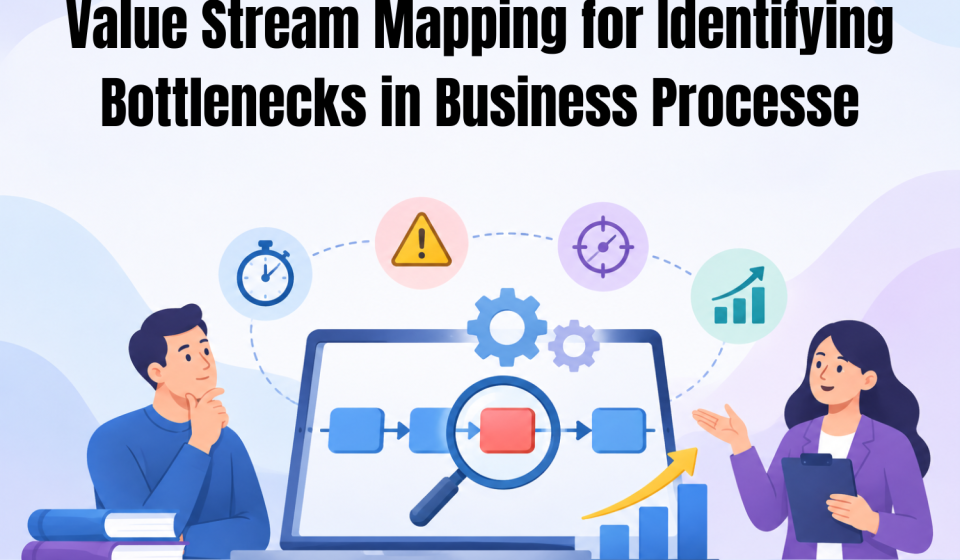
Value Stream Mapping is a method of visualising how work flows through the system. It demonstrates significant activities, information flow and wait times.
This will aid business process improvement by identifying the point of delay in the process and the activities that need to be addressed.
Identifies Delays Between Process Activities
Work delays frequently occur in business processes when it is passed from one stage to another.
These delays can be due to approval processes, resource or communication issues.
Value Stream Mapping allows teams to uncover work that hasn’t been completed or is waiting needlessly. Knowing these delays helps with the identification of process bottlenecks and helps organisations find practical solutions to improve workflow efficiency.
Highlights Activities That Do Not Add Value
Not all activities are directly related to customer satisfaction or business results.
Some tasks have more than one approval, more than one check or too much movement of information.
Lean Six Sigma Training helps to gain insight into identifying waste and optimising processes. Organisations can identify and eliminate activities that are not necessary, while retaining vital quality and compliance requirements, via waste reduction techniques.
Supports Better Resource Allocation
Poorly allocated employees, equipment or other resources can slow operations in the business.
Over or underloaded activities are possible.
Using Value Stream Mapping, organisations can determine these imbalances and see how much they affect performance. Optimising resources is a key aspect of reducing waiting periods in a business by making the most of the resources that are available.
Helps Reduce Rework and Process Errors
Mistakes can cause further work and delays in completing vital tasks.
Frequent corrections can also raise expenses and impact customer satisfaction.
Lean Six Sigma Training teaches techniques to analyse problems with processes and enhance product quality. When these principles are coupled with process improvement methods, they enable organisations to explore common challenges or issues and minimise the need for repetitive actions.
Improves Workflow Efficiency
Excess movement or ambiguous ownership of work is a sign that a process might be made more efficient.
Value Stream Mapping is one method that could assist in identifying such obstacles and forming new ways of organising work.
Workflow optimisation is not about cutting corners, but about finding simpler ways of working. That means companies may minimise disturbance and improve the flow of products and information.
Supports the Development of Improved Processes
Mapping bottlenecks is just the first step in process improvement.
Teams must also determine how activities should operate after unnecessary delays and inefficiencies are addressed.
Value Stream Mapping supports the creation of a future process map that reflects proposed improvements. This enables organisations to have more defined workflows, waste reduction and more consistent business performance.
Strengthens Customer Value Delivery
Customers want products and services to be delivered quickly and to be of a high standard.
Time delays may result in poor customer service and stem from bottlenecks in the process.
The first step in creating customer value is figuring out what activities meet customer needs. Enhancing these activities and minimising time consuming delays will enable businesses to provide more dependable services and improve customer relationships.
Encourages Continuous Process Improvement
With customer expectations and operational requirements, business processes must be continually evaluated.
Professionals gain insight into structured ways to improve the performance of a business through Lean Six Sigma Training.
By continuously improving processes, organisations can take a look at their current workflows, evaluate the outcomes and uncover new avenues for efficiency. Standardised process reviews also reduce the likelihood of past bottlenecks cropping up again.
Conclusion
Value Stream Mapping enables organisations to analyse business processes, eliminate unnecessary activities and understand the bottlenecks. Teams can identify practical solutions that can enhance efficiency and customer satisfaction by identifying workflow delays, resource allocation and other issues. Frequent process reviews can also spark improved decision making and ongoing process improvement. Value Stream Mapping can help businesses increase their productivity and provide increased value. Professionals can strengthen their process improvement skills through Lean Six Sigma Training from The Knowledge Academy, a leading global training provider.