
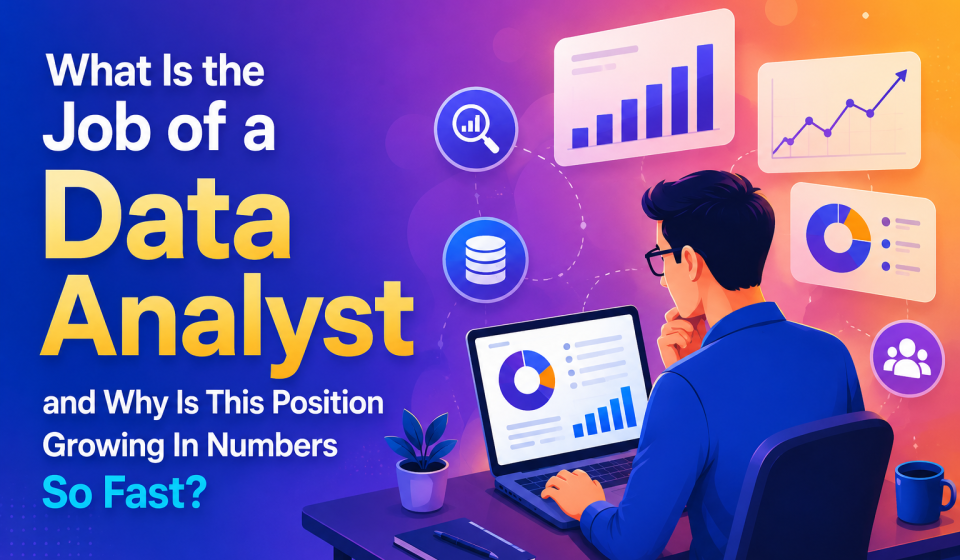

On paper, being a data analyst doesn’t sound like much: glance at some numbers and tell someone what they add up to, but the job underneath that has gotten a lot heavier over the past couple of years. Handing someone a spreadsheet and a monthly summary used to be enough, and that’s largely stopped being true. What companies actually want now is someone who’ll go into the database themselves, pull the data out, deal with whatever mess is sitting in it, set up a dashboard that refreshes on its own, and then explain plainly why one region’s sales dropped while a neighbouring one held steady.
Table Of Content
- How Strong Is the Data Analyst Job Market Right Now?
- What Are Our Students Actually Earning After This Certification?
- What Skills and Tools Does This Program Actually Cover?
- What Jobs Can Be Targeted After Data Analyst Certification In Pune and Mumbai Cities?
- How Do You Actually Get Placements in the Data Analytics Sector?
- Why SevenMentor Is a Strong Choice for This Getting Training And Placement As Data Analyst?
- Ready to Start Your Data Analytics Career Now?
That’s basically why interest in a proper Data analyst course in Pune has climbed the way it has. Between IT services firms, manufacturing companies, and a fintech scene that keeps expanding in Pune, this city has plenty of demand for this exact kind of work, and hardly any of it is looking for someone who’s only good at one narrow tool anymore. SQL or even something like Power BI or Tableau for visualization, along with just enough Python to handle the boring,g repetitive reporting bits. That combination has turned into the expected starting point rather than something extra to bring up in an interview.
Mumbai wants roughly the same skill set, though the industries asking for it differ a bit. Banking, insurance, and a thick cluster of retail and D2C brands based there tend to need analysts comfortable with transaction data or customer behaviour patterns specifically, and that usually favours people who’ve actually worked through messy real datasets during training instead of only ever touching clean sample files. Deciding between data analyst training in Mumbai and a Pune-based option really just comes down to picking between two cities after the same core skill set, applied to slightly different kinds of businesses.
How Strong Is the Data Analyst Job Market Right Now?
The honest answer is genuinely strong, and there’s enough data behind it to say so with some confidence rather than just repeating what every institute claims. India’s data and analytics job market is expected to add well over 10 million roles by 2026, and a large share of that hiring sits in exactly the sectors both Pune and Mumbai are known for:r, IT services, BFSI, manufacturing, and retail.
Pay reflects this fairly clearly too. Freshers typically start somewhere around ₹3.5–4.5 LPA, though that number climbs noticeably for candidates who walk in already comfortable with SQL and at least one visualization tool rather than relying purely on Excel. Give it two to three years, and mid-level analysts are commonly earning ₹6.5–10 LPA, with BFSI and fintech companies in Mumbai generally sitting a bit higher on this range than similar roles elsewhere, mostly because of how data-heavy those industries already are.
A few things stand out for anyone weighing this seriously right now. There’s a shortage of well over 200,000 analytics professionals nationally, and that gap alone is a big part of why demand hasn’t slowed down even while hiring has cooled off in some other tech roles. Power BI shows up in a large majority of analytics job postings today. Python isn’t too far behind it, and knowing both alongside SQL tends to widen what someone qualifies for a lot more than sticking to just one tool ever does.
None of this guarantees a strong offer by itself, though. What tends to separate candidates who actually get hired from ones who don’t is real project work behind the tool knowledge, something a structured data analyst training in Pune program can build in directly rather than leaving someone to figure it out on their own through scattered tutorials.
What Are Our Students Actually Earning After This Certification?
- Real placement numbers tend to say more than any tool list ever could, so here’s roughly where past batches from Pune and Mumbai have landed after finishing.
- Students joining with little prior background mostly started in junior analyst roles first, generally somewhere around ₹3.5–4.5 LPA, depending on the company and city.
- A fair number of Mumbai placements landed at BFSI or retail firms specifically, given how dense that hiring pool is there, while Pune placements spread a bit more evenly across IT services and manufacturing companies.
- Within a year or two, a good number moved up once they’d built a stronger project portfolio, particularly students who got genuinely comfortable with SQL and Power BI together rather than knowing just one.
- Pay for this group generally sat between ₹6–9 LPA, and the ones who’d also picked up Python for automation tended to land toward the higher end of that range.
- A smaller group who came in with some prior work experience, often switching over from a non-technical role entirely, used this certification to move directly into business intelligence or reporting-analyst positions, with a few crossing ₹8 LPA in their very first offer post-certification.
- None of these numbers come with a guarantee attached, since so much still depends on how many real projects someone actually builds and how confidently they can explain their reasoning in an interview.
- What’s held up fairly consistently across both cities, though, is that students who took the SQL and Power BI combination seriously, instead of skimming past it, ended up with noticeably stronger offers than those who leaned on just one tool alone.
What Skills and Tools Does This Program Actually Cover?
A lot of data analytics programs list out software names and call it a curriculum, without really explaining when an analyst would reach for each one on an actual job. This data analyst course in Pune ties every tool to a real use case instead, and the same structure carries over for anyone joining the Data analyst course in Mumbai batches too.
Here’s roughly how the program builds up:
- Excel and spreadsheet fundamentals — pivot tables, VLOOKUP, and enough formula work to run quick analysis before anything heavier comes into play
- SQL for querying and joins — pulling and combining data straight from a company database, which matters a lot more day-to-day than most beginners expect
- Power BI dashboarding — building interactive reports that refresh automatically instead of a static file someone has to redo every week
- Tableau for visualization — useful for client-facing or leadership-level reports where presentation carries as much weight as the numbers themselves
- Python and pandas — mostly for automating repetitive reporting tasks and cleaning datasets too messy or too large for a spreadsheet to manage well
- Statistics fundamentals — enough regression and hypothesis testing that a trend can actually be explained instead of just pointed at on a chart
Students work through live datasets pulled from genuine business scenarios throughout, sales figures, customer churn, inventory tracking, rather than the clean sample files that rarely match what a real job actually looks like. Batches training out of our Shivaji Nagar and Kharadi centres in Pune, and our Dadar and Andheri centres in Mumbai, all run through the same set of projects, so location doesn’t change what actually gets taught.
By the time this wraps up, most students walk away with two or three portfolio-ready projects they can talk a recruiter through in real detail, rather than just listing software names on a resume and hoping that’s enough on its own.
What Jobs Can Be Targeted After Data Analyst Certification In Pune and Mumbai Cities?
Real placement numbers tend to say more than any tool list ever could, so here’s roughly where past batches from both cities have landed after finishing this data analyst class in the Pune and Mumbai programs
- Freshers with little prior background mostly started in junior analyst roles first, generally around ₹3.5–4.5 LPA. A fair number of Mumbai placements landed at BFSI or retail firms near BKC and Lower Parel specifically, given how dense that hiring pool is in that part of the city, while Pune placements spread more evenly across IT parks in Hinjewadi and manufacturing firms closer to Chinchwad
- Students one to two years out who built a stronger project portfolio, particularly ones comfortable with SQL and Power BI together, generally moved into roles paying ₹6–9 LPA, with the Python-literate group landing toward the higher end of that
- Career switchers with prior work experience, often coming from a non-technical background entirely, used this certification to move directly into business intelligence or reporting-analyst roles, with a few crossing ₹8 LPA in their very first offer after certification
- Mumbai-based placements in BFSI specifically tended to sit slightly higher on average than similar roles elsewhere, mostly a reflection of how data-heavy that industry already runs
None of these numbers come with a guarantee attached, since so much still depends on how many real projects someone actually builds and how confidently they can explain their reasoning in an interview. What’s held up fairly consistently across both the Pune and Mumbai batches, though, is that students who took the SQL and Power BI combination seriously, instead of skimming past it, ended up with noticeably stronger offers than those who leaned on just one tool alone.
How Do You Actually Get Placements in the Data Analytics Sector?
Plenty of people get stuck right at the starting line, not sure if Excel comes first, or Python, or whether to just go chase certifications before even knowing what half of it’s actually meant for. A steadier way through this exists, though, and it looks a lot less scattered than that.
- Get comfortable with Excel and SQL first — this is genuinely where most real analyst work begins day to day, pulling data and cleaning it before anything fancier touches it
- Move into Power BI or Tableau next — once the basics are solid, visualization tools start making sense as an extension of the same work rather than a separate skill
- Add Python once the core tools feel natural — mostly for automating the repetitive parts of reporting that eat up hours every week otherwise
- Practice on messy, real datasets rather than only clean sample files, since that’s where most of the actual learning quietly happens
This is roughly where a structured data analytics course in Pune and Mumbai fits into the picture. Instead of piecing this sequence together alone through scattered tutorials, an instructor walks through it step by step, catching mistakes early rather than three months later during an actual interview. Students training out of Pune’s Shivaji Nagar or Kharadi centres, and Mumbai’s Dadar or Andheri batches, all go through the same project-based sequence, so the city someone trains from doesn’t change the depth of what gets covered.
Why SevenMentor Is a Strong Choice for This Getting Training And Placement As Data Analyst?
Plenty of institutes across both cities promise similar things: hands-on training, placement support, real projects. Most of it sounds nearly identical until you’re actually sitting through the classes.
- Small batch sizes, usually under 20 students, so a genuine doubt about why a SQL join isn’t returning the right rows doesn’t get glossed over just to keep class moving
- Trainers with real industry background, having worked as analysts or BI professionals themselves rather than only ever having taught from a slide deck
- Flexible batch timings that you can take across both Pune and Mumbai centres throughout the weekday, evening, and weekend options. This is so the schedule bends around working professionals rather than the other way around for each and every one.
- Recordings aare vailable for every session, which can become very useful for anyone who misses a class and then work or has a late commute across either city from Pune to Mumbai
- Placement support built into the last stretch of training, resume help, mock interview, and direct introductions to hiring contacts across Pune’s IT firms and Mumbai’s BFSI companies
- A free repeat option, so falling behind in one batch doesn’t mean paying again just to catch up in the next
None of this is particularly flashy. It just means students leave with real dashboards and queries they can actually talk through, not a certificate sitting on top of very little practical work.
Ready to Start Your Data Analytics Career Now?
Seats at our Pune and Mumbai centres are filling up quickly right now, and there’s a fee discount currently running that’s worth locking in before it ends. A few hiring partners across both cities have interview drives coming up in the next couple of months too, so finishing certification before those rounds open puts you ahead of anyone waiting for the next cycle.
If you want to sharpen a specific skill before committing to the full course, a couple of related options pair well alongside it:
- SQL Training — useful if querying and joins still feel shaky
- Power BI Course — worth it if dashboards and visualization are your main interest right now
Reach out to your nearest branch in Pune or Mumbai, or book a free demo session, to check seat availability and lock in the discounted fee before the next batch fills up.