
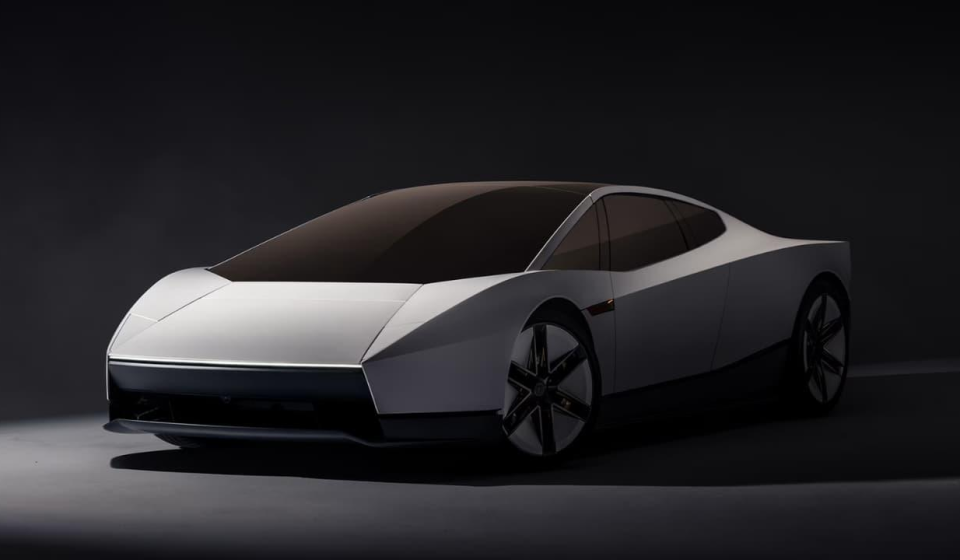

Tesla has recently presented its Roadster model which was last exhibited in a show that was held in Texas by the event organizers. This electric vehicle concept integrates technology of electric vehicles (EV) with a kind of system that would make propulsive action possible in the air.
Table Of Content
During the presentation held on October 15, 2026 the new sports car was shown to be uses a system of suction and thrust for a very brief period of time.
Considering these new technical features raises a special question: how far can the construction of a vehicle be improved for flying?
The company claims that its Roadster vehicle, which is called Rocket, has flying capacity but there are still some relevant questions about its practical abilities and safety.
How Does Tesla’s Rocket-Powered Roadster Work?
According to Tesla’s official Roadster website, the Rocket configuration makes use of a multi-mode suction system along with cold-gas thrusters which are affixed all around the vehicle. In contrast to standard rocket engines which use combustion to produce thrust, cold-gas systems simply release high-pressure gas via nozzles to generate thrust.
The way in which the thrust is applied is dependent on the direction of the thrusters. Careful use of thrust might assist with the movement and rotation of the vehicle itself.
This method applied to a vehicle gives rise to a number of difficulties. A road vehicle should be stable when moving in contact with the surface while a space vehicle should use its thrusts in air without touching anything.
What Role Does the Suction System Play?
One of the remarkable characteristics of Roadster is its system of multi-mode fan and ground-sealing. Tesla claims that the system takes air from beneath the vehicle, resulting in downforce and improving grip, thus allowing the vehicle to stay on an inverted surface, when conditions are right.
In essence, this technology tackles the problem with grip at high velocities. Downforce relies heavily on the way air flows around the wings and bodywork. However, the powered suction technology allows the vehicle to obtain additional force even when it is not moving too fast.
The downside of this technology is that it is complex, as fans consume energy, as well as seals and ducts must operate properly in varying conditions. Engineers also have to think of heat, vibration, wear, and behavior of the system in the absence of electricity or air.
In addition to that, creating downforce on the surface of something is far from flying safely.
Why Is Controlling an Airborne Car Difficult?
A standard automobile depends on its wheels, suspension, and steering for road operation. But once in the air, it cannot perform in the same manner as before. Therefore, the necessary forces controlling motion will have to be produced by the main systems.
This means that engineers will have to put together thrust output, stability of the car, and the onboard software control in a matter of seconds. Even the slightest error in the thrust direction may lead to unwanted rotation or motion. Additional factors may make the situation more complicated. The vehicle may be affected by the wind; its mass may change; or the gas pressure may vary.
The compressed gas systems create additional problems from the packaging standpoint. Tanks, valves, pipes, and thrusters take up space and add to the overall weight. Pressure vessels have to withstand serious conditions of use and the structure has to handle the pressure produced during the starting and controlling.
As seen from the complexity of the situation, it is extremely difficult to combine the features of flights that a car has with the range, comfort, efficiency, and usability of a car on the road.
Can the Roadster Become a Practical Flying Car?
Tesla demonstrated a prototype that was capable of moving smoothly in the air, but the company has failed to prove its flying capabilities. According to The Associated Press, Tesla has no plans to begin production before 2028.
The company has branded the rocket option as an invite-only model, meaning this vehicle hasn’t gone through the necessary regulations for public road usage. These differences matter because the successful demonstration does not mean that the vehicle is ready to be manufactured.
A flying car still needs to go through plenty of testing regarding its control systems, structure integrity, and different emergency situations. Authorities would need to establish which regulations apply to the vehicle. A flying vehicle that is designed to perform maneuvers is different from the one intended for passenger transportation.
What Tesla’s Roadster Could Mean for Engineering
The Roadster concept illustrates how technologies from different engineering fields can be combined to explore new performance possibilities. Its proposed use of cold-gas thrusters and powered suction systems creates opportunities to examine vehicle control, pressure-system design, and the limits of conventional automotive architecture.
Engineering innovation also reaches audiences through different forms of technology and entertainment, from experimental vehicles to digital experiences such as Jili games. However, the Roadster’s real significance will depend on whether its systems can operate reliably and safely outside a controlled demonstration.
Engineers must consider not only what a prototype can do, but also how consistently it performs, how failures are managed, and whether its capabilities justify the added complexity. Until its flight capabilities are independently demonstrated and the relevant safety requirements are addressed, it is more accurate to view the Roadster as an ambitious vehicle concept than as a practical replacement for conventional aircraft.